The Impact of Tax Law Changes on Corporate Payroll and HR Compliance
Last month, a payroll manager at a mid-sized tech company discovered something unsettling during a routine audit. Three months of overtime calculations were wrong. Not drastically wrong, but wrong enough to trigger penalty notices from the state. The culprit wasn’t a software glitch or human error in the traditional sense. It was a tax law update that changed how certain bonuses factored into the overtime rate calculation. HR knew about the policy change. Payroll knew about the tax update. But nobody connected the dots until it was too late.The Impact of Tax Law Changes on Corporate Payroll and HR Compliance
This happens more often than most organizations care to admit. Tax laws don’t just affect your year-end filings or quarterly reports. They reach deep into the machinery of how you pay people, classify jobs, track benefits, and document every single employment decision. When Washington or your state capitol tweaks the tax code, the shockwaves hit payroll first and HR second, often within the same pay cycle.
When Payroll Becomes Everyone’s Problem
Most employees think payroll is automatic. You work, you get paid, taxes come out, and everyone moves on. Behind the scenes, it’s chaos held together by policy documents, tax tables, and a whole lot of coordination between departments that don’t always speak the same language.
Here’s what actually happens when a tax law changes. The finance team gets an alert from their tax software provider or their CPA firm. Payroll gets a memo about new withholding tables or contribution limits. HR gets a vague email about reviewing employee classifications. Then everyone assumes someone else is handling the details.
The problem is that payroll can’t just flip a switch and comply with new tax rules. Every change has upstream dependencies. If the law redefines what counts as taxable wages, HR needs to confirm whether certain stipends or reimbursements are still structured correctly. If employer contribution limits shift, benefits administration needs to update enrollment materials. If overtime calculation rules get clarified, job descriptions and exemption statuses might need a second look.
What looks like a simple tax adjustment on paper becomes a multi-department project that nobody planned for and nobody has time to manage properly.
The One Big Beautiful Bill Nobody Talks About at Happy Hour
You’ve probably heard about major tax legislation in the news, but the real impact doesn’t show up in headlines. Take something like the One Big Beautiful Bill that rolled through recently. Most coverage focused on top-line numbers and political drama. What actually landed on HR and payroll desks was a mess of new employer reporting requirements, adjustments to how certain contributions are tracked, and revised timelines for reconciliation.
For payroll teams, this meant reconfiguring systems to capture data they weren’t previously tracking. For HR, it meant updating internal policy language to reflect participation criteria that didn’t exist six months ago. And for employees, it meant confusing emails trying to explain changes that even the people writing them didn’t fully understand yet.
The dirty secret about these legislative updates is that compliance isn’t about reading the law and checking a box. It’s about translating legal language into payroll system logic, then making sure that logic matches what HR promised employees in the handbook, which also needs to align with what finance reports to regulators. When any link in that chain breaks, you get payroll errors, compliance violations, or both.
Why Overtime Is Still a Headache in 2026
You’d think we’d have overtime figured out by now. It’s been federal law since 1938. But every few years, someone reinterprets what counts as the regular rate of pay, and suddenly payroll teams are rebuilding their calculation engines.
The latest round of discussions around overtime rules highlighted something most employees don’t realize. Your overtime rate isn’t just time-and-a-half of your hourly wage. It’s time-and-a-half of your regular rate, which can include certain bonuses, shift differentials, and other pay elements that vary by pay period.
When tax law changes affect how those components are classified or taxed, the math changes. A quarterly performance bonus that was previously excluded from the regular rate might now need to be included. A non-discretionary incentive that wasn’t taxed a certain way before might now carry different withholding requirements.
Payroll has to run parallel calculations to validate the new approach. HR has to confirm that job classifications still make sense under the updated rules. And neither department can afford to wait until the next audit to find out they got it wrong.
This is where organizations get burned. They assume compliance is a payroll responsibility, so HR stays hands-off. Or they assume it’s an HR policy issue, so payroll just runs the numbers they’re given. The reality is that overtime compliance sits in the gap between the two functions, and it only works when both sides are actively collaborating.
The Employer Participation Nobody Asked For
Here’s a newer wrinkle that’s forcing payroll and HR to work even closer together. Programs like the Employer Participation in Repayment Act create structured employer involvement in employee repayment programs that flow directly through payroll.
On the surface, it sounds straightforward. Employers contribute to employee repayment accounts, payroll processes the contributions, everyone benefits. In practice, it’s another layer of complexity stacked on top of an already complicated system.
Payroll teams need to configure new deduction codes, track contribution amounts separately from regular compensation, and ensure the data flows correctly to year-end tax forms. HR needs to define eligibility rules, communicate the program to employees, and update policy documents to reflect the new benefit.
The challenge is timing. If HR rolls out the program before payroll is ready, employees enroll but don’t see the contributions they were promised. If payroll sets it up before HR finalizes the policy, the system logic might not match the actual eligibility rules. And if either side makes a mistake, it doesn’t just affect one employee. It affects everyone in the program, potentially for multiple pay periods before anyone notices.
This kind of legislation shifts the compliance burden from abstract policy to operational execution. It’s not enough to have the right intent or the right policy language. The actual payroll transactions have to be correct, on time, and properly documented every single pay cycle.
What Actually Breaks When You’re Not Paying Attention
The errors that show up months later during audits almost always trace back to the same root cause: someone updated one system but not the others.
Payroll updated the tax tables but didn’t flag the changes for HR. HR updated the employee handbook but didn’t loop in payroll on the compensation policy shift. Finance changed how they’re reporting certain benefits but didn’t tell anyone until reconciliation time.
The most common failure mode is the silent drift. Everything seems fine for weeks or months. Paychecks clear, employees don’t complain, reports get filed. Then an audit or a sharp-eyed employee notice triggers a review, and suddenly you’re looking at retroactive corrections across multiple pay periods.
Incorrect withholdings are probably the most visible problem. Employees notice when their take-home pay changes unexpectedly. But misclassified workers are the bigger risk. If a tax law change affects how you determine exempt versus non-exempt status, and HR doesn’t catch it, you could have employees classified wrong for months. That’s not just a payroll fix. That’s back pay, penalties, and a legal exposure that ripples through the entire organization.
Then there’s the reporting gap. New tax laws often come with new reporting requirements. If payroll doesn’t know what HR promised in terms of benefits or participation, the data on your quarterly filings won’t match your internal records. Regulators don’t care whose fault it was. They just see the discrepancy.
The Trends Nobody’s Talking About Yet
Looking ahead to the rest of 2026, there’s a quiet shift happening in how organizations approach payroll compliance. It’s moving from a reactive, fix-it-when-it-breaks model to something more structured and preventive.
More companies are building joint review processes into their payroll cycles. After every major tax law update, HR and payroll sit down together and walk through the implications before anything goes live. They’re documenting decision logic, not just the decisions themselves. They’re creating audit trails that show why certain configurations were chosen and what policy rationale supports them.
This isn’t about adding bureaucracy. It’s about recognizing that payroll compliance is now too complex for any single department to own completely. The organizations that figure this out early are the ones that aren’t scrambling every time a new bill passes.
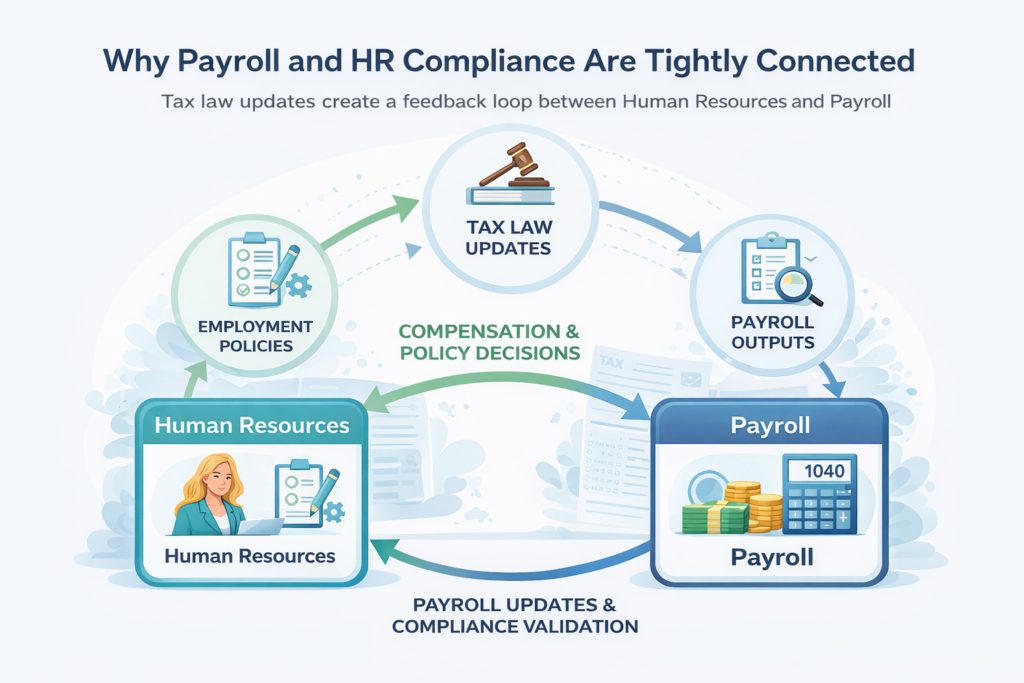
There’s also more emphasis on integration. Not just system integration, though that matters too. Functional integration between payroll, HR, finance, and legal. Tax law changes touch all of those areas, and the handoffs between them are where compliance falls apart.
The smartest companies are treating payroll governance as a shared responsibility framework rather than a single department’s job. They’re investing in cross-functional training so payroll understands HR policy and HR understands payroll mechanics. They’re building compliance checkpoints that require sign-off from multiple stakeholders before changes go live.
Why This Actually Matters More Than It Used to
A decade ago, you could probably get away with slower adaptation to tax law changes. Enforcement was less aggressive, systems were simpler, and the penalty structures didn’t hit as hard.
That’s not the world we’re in anymore. Regulators have better data, better tools, and more pressure to close compliance gaps. Employees are more aware of their rights and more willing to question discrepancies. And the complexity of the tax code itself has increased to the point where manual tracking isn’t realistic anymore.
When a tax law changes now, you have weeks, not months, to implement it correctly. Your payroll system needs to be updated, your HR policies need to be aligned, and your documentation needs to be audit-ready from day one. There’s no grace period for figuring it out as you go.
The organizations that treat this seriously are building muscle memory for change management. They’re not reacting to each new law as a unique crisis. They’re running a repeatable process that accounts for the predictable ways tax changes affect operations.
And they’re doing it because they’ve learned the hard way that fixing payroll errors after the fact is exponentially more expensive than preventing them upfront. Retroactive corrections, penalty payments, employee relations damage, and audit costs add up fast. Prevention is cheaper, even when it requires more coordination and planning.
My words:
Tax law changes aren’t going away. If anything, the pace is accelerating as governments look for new revenue sources and new ways to regulate employer behavior. The organizations that survive this environment intact are the ones that stop treating payroll and HR compliance as separate problems.
They’re building integrated workflows, shared accountability structures, and proactive monitoring systems. They’re investing in the unglamorous work of documentation and validation. And they’re recognizing that compliance isn’t a box to check—it’s an ongoing operational discipline that requires constant attention.
The payroll manager who discovered those overtime errors three months too late learned something valuable. The problem wasn’t a lack of effort or expertise. It was a lack of structured coordination between the people who understood the policy and the people who executed the calculations.
That gap is where most compliance failures happen. And closing it requires intentional process design, not just better software or smarter people. Tax law changes will keep coming. The question is whether your organization is set up to handle them without breaking something critical in the process.
Disclaimer: The information provided in this article is for educational purposes only and does not constitute legal, tax, or financial advice. Tax laws and regulations are subject to change. Please consult with a qualified CPA, tax attorney, or payroll specialist regarding your specific business circumstances.

Karthick Raja is an MBA-qualified Finance & HR professional and founder of Business Tax Hub, with 10+ years of hands-on experience managing finance operations, taxation, payroll compliance, and HR functions. He helps students and professionals navigate the U.S. corporate landscape by translating real-world business experience into practical, job-ready career growth.