How to Align HR Processes with Corporate Financial Goals in 2026
Why This Topic Actually Matters
Let me be real with you for a second. When I first started working in HR and finance over a decade ago, nobody in the HR department talked about financial goals. HR handled hiring, onboarding, and keeping people happy. Finance handled budgets, forecasts, and numbers. The two departments operated like two completely separate islands — and nobody questioned it.
That was a mistake. A big one.
Fast forward to today, and the companies that are actually winning — the ones growing fast, keeping costs under control, and retaining the best talent — are the ones where HR and finance work hand in hand. In 2026, aligning HR processes with corporate financial goals is not a nice-to-have. It is a core business requirement.
I have spent over 10 years managing finance operations, taxation, payroll compliance, and HR functions inside real companies. I have seen firsthand what happens when HR and finance are misaligned — and I have also seen the dramatic difference when they finally get on the same page. In this article, I am going to break down exactly how this alignment works, why it matters so much, and give you practical steps you can actually use — whether you are an HR professional, a finance team member, or a student trying to understand how modern businesses actually operate.
What Does It Actually Mean to Align HR with Financial Goals?
Before we dive into the how, let us make sure we understand the what — because a lot of people use this phrase without really knowing what it means in practice.
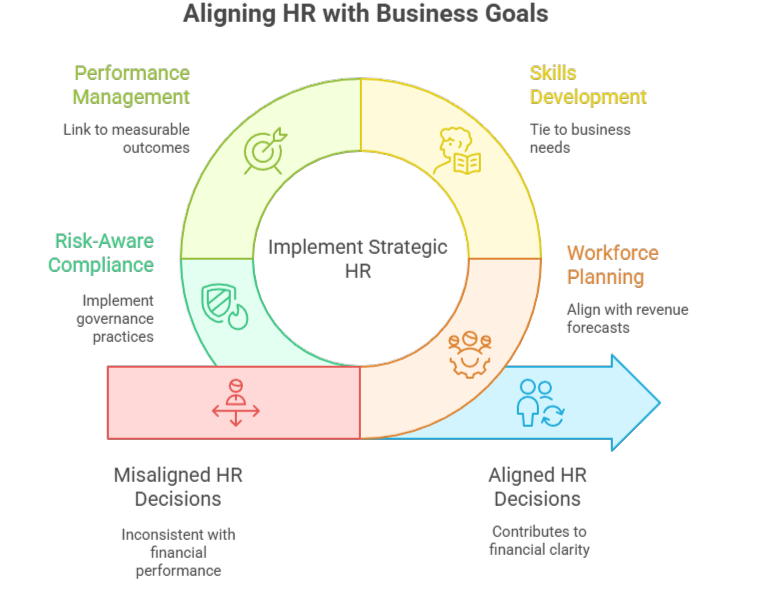
Aligning HR with corporate financial goals simply means this: every major decision the HR department makes should connect back to the company’s financial health. Hiring decisions, compensation structures, training programs, performance reviews — all of it should support the business’s ability to grow revenue, control costs, and manage risk.
Think about it this way. If a company decides to expand into a new market, the finance team will set a budget for that expansion. The HR team needs to know that budget so they can hire the right people at the right cost, build the right training programs, and plan for the right headcount. If HR just hires based on gut feeling without looking at the financial plan, the company ends up either overspending or understaffing — and both of those outcomes hurt the business badly.
This is not theory. I watched this exact scenario play out at a mid-size company I consulted for. Their HR team was hiring aggressively for a new division, but nobody had checked whether the budget could actually support that growth. By the time finance flagged the issue, they had already committed to salaries they could not sustain. It took six months to fix, and it cost the company in ways that went far beyond money — it hurt morale, it damaged trust between departments, and it set their expansion timeline back by almost a full year.
Understanding how companies design the way work happens is the first step to seeing why this alignment matters so much at a structural level.
Why 2026 Is Different — What Has Changed
A lot of HR professionals I talk to ask me, “Why is everyone suddenly talking about HR and financial alignment now? Was not this always important?” The answer is yes — but 2026 has brought a few major shifts that have made it impossible to ignore anymore.
First, the pace of business change has accelerated dramatically. Companies are not just competing locally anymore. They are competing globally, and the financial pressures that come with that are intense. HR teams that cannot keep up with those financial realities become a liability instead of an asset.
Second, data has changed everything. A few years ago, HR decisions were mostly based on intuition and experience. Today, we have access to workforce analytics, engagement data, productivity metrics, and financial forecasting tools that can tell us exactly how people-related decisions impact the bottom line. There is no excuse anymore for making HR decisions in the dark.
Third, and this one is big — investors, boards, and leadership teams are now holding HR accountable for financial outcomes. If you are an HR leader in 2026 and you cannot explain how your decisions connect to the company’s financial performance, you are going to struggle in that role.
I have seen this shift happen in real time across the companies I have worked with and advised. The HR professionals who adapted and learned to think financially — those are the ones who got promoted. The ones who did not? They became irrelevant.
The 5 Pillars of HR-Financial Alignment — A Framework I Actually Use
Over the years, I have developed a simple framework that I use when I am helping companies align their HR and finance teams. I call it the 5 Pillars, and it is based on real mistakes I have seen — and real wins I have helped create.
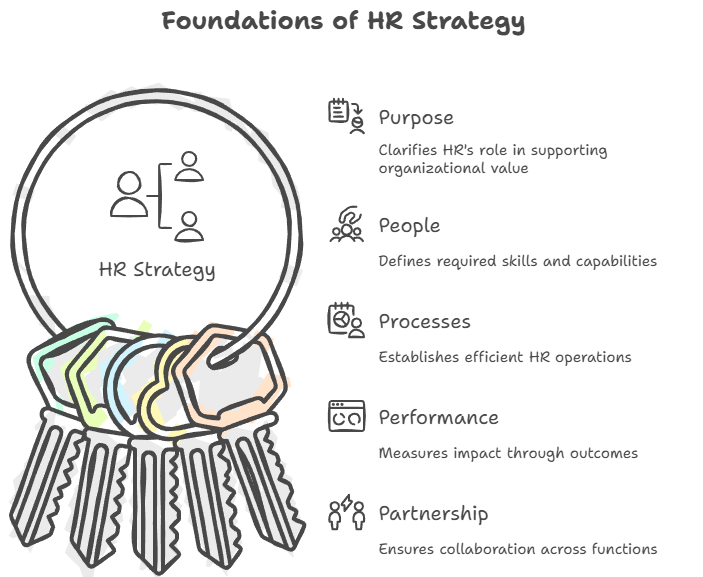
Pillar 1: Workforce Planning That Connects to Revenue
The first and most important pillar is workforce planning — but not the kind you learned in a textbook. Real workforce planning means sitting down with the finance team, looking at revenue forecasts, and asking the question: “Based on where this company is going financially, how many people do we need, in what roles, and at what cost?”
I worked on a workforce planning project about three years ago where the company was expecting a 30% revenue increase in the next fiscal year. The old way of doing things would have been to just hire more people and hope for the best. Instead, we mapped out exactly which roles would drive that revenue, what skills those roles required, and what the total cost of hiring and onboarding those people would be. We presented that plan to the finance team with actual numbers, and they approved it immediately — because it made financial sense.
If you want to understand how to build a strong talent pipeline that supports this kind of financial planning, my article on talent acquisition strategy and how organizations build long-term hiring success goes deep into exactly how this works.
Pillar 2: Compensation That Reflects Performance — Not Just Market Rates
Here is something that most HR teams get wrong. They set compensation based purely on what the market is paying. And while market rates matter, that is only half the equation. The other half is performance.
When I was managing payroll compliance and HR functions, I saw companies pay top dollar to employees who were not delivering results — simply because the market rate was high. And I also saw companies underpay talented people who were actually driving revenue, because nobody had connected compensation to performance metrics.
In 2026, compensation structures need to be tied directly to measurable outcomes. That means working with finance to define what “good performance” looks like in financial terms, and then building pay structures that reward that performance. This is not just about keeping costs down — it is about making sure the people who contribute the most to the company’s financial success are the ones who are being rewarded for it.
Pillar 3: Training and Development Tied to Business Needs
Training is one of the biggest budget items in HR — and it is also one of the most wasted. I have seen companies spend hundreds of thousands of dollars on training programs that had absolutely nothing to do with what the business actually needed. Employees would sit through workshops, get certificates, and then go right back to doing exactly what they were doing before.
That is not alignment. That is a waste.
Real training alignment means looking at the company’s financial priorities and asking: “What skills do our people need to develop in order to hit those priorities?” If the company is trying to grow its international business, then training should focus on cross-border compliance, global communication, and international market knowledge — not generic leadership workshops.
When I redesigned a training program for a finance team I was working with, we cut the budget by 40% and saw a 25% improvement in productivity. How? We eliminated everything that was not directly connected to the skills the team needed to do their jobs better. It was that simple.
Pillar 4: Performance Management That Actually Measures What Matters
Performance reviews are supposed to be one of the most important tools in an HR professional’s toolkit. But in practice, most performance reviews are a joke. They happen once a year, they are filled out based on vague impressions, and nobody actually does anything with the results.
That needs to change — especially if you want HR to be taken seriously as a financial contributor.
Performance management in 2026 needs to be outcome-based. That means setting clear, measurable goals that are tied directly to business results — not activity. Instead of measuring how many hours someone worked or how many meetings they attended, you measure what they actually produced and how much value that created for the company.
I started implementing outcome-based performance metrics about five years into my career, and the difference was night and day. Managers stopped guessing about who was contributing and who was not. Employees knew exactly what was expected of them. And the finance team could finally see a direct connection between people decisions and financial results.
If you want to sharpen your ability to communicate across teams and lead effectively in this kind of environment, I wrote a detailed guide on soft skills for finance professionals and bridging the gap between data and people that is worth reading.
Pillar 5: Risk-Aware Compliance and Governance
The last pillar is one that most people overlook — but it is actually one of the most financially impactful. Compliance is not glamorous, but when it fails, the consequences are devastating.
HR compliance includes everything from labor law adherence to payroll accuracy to workplace safety regulations. And every single one of these areas carries financial risk. One compliance failure can result in lawsuits, fines, and reputational damage that costs a company far more than any training program or hiring initiative ever would.
In my experience managing payroll compliance and HR governance, I learned early on that the companies that invest in compliance infrastructure actually save money in the long run. They avoid the costly surprises that come with audits, penalties, and legal battles. And when HR compliance is aligned with the company’s financial risk management strategy, it becomes a protective shield around the business — not just a checkbox exercise.
Tax law changes are one of the biggest compliance risks that HR teams face, and they happen more often than most people realize. I covered exactly how these changes ripple through payroll and HR in my article on the impact of tax law changes on corporate payroll and HR compliance.
Real Story: How I Helped a Company Fix Their HR-Finance Disconnect
I want to share a specific story here, because I think it will make everything I have been talking about feel a lot more concrete.
About two years ago, a mid-size manufacturing company reached out to me for help. They were losing money — not because their product was bad or because the market had shifted, but because their HR and finance teams were so out of sync that it was costing them in ways they had not even noticed.
Here is what was happening. The HR team was hiring based on headcount targets that had been set six months earlier. But the business had changed. Revenue in one division had dropped by 20%, and another division was growing twice as fast as expected. Nobody had gone back and updated the hiring plan to match the new financial reality. Result? They were overstaffing in a shrinking division and understaffing in the one that was actually making money.
On top of that, their onboarding process was taking almost two months from hire to fully productive employee. In a fast-moving business, that is an enormous cost — both in direct expenses and in lost productivity during that ramp-up period. I looked into their process and found that a lot of the delay was coming from disconnected systems and unclear ownership between HR and finance during the onboarding workflow.
We fixed it in three steps. First, we set up a monthly sync between HR and finance where they would review headcount plans against the latest financial forecasts together — not separately. Second, we streamlined the onboarding process by clarifying exactly who owns what and automating the parts that were being done manually. Third, we built a simple dashboard that tracked the cost and productivity impact of each new hire in real time, so both teams could see the financial impact of HR decisions as they happened.
Within four months, the company cut their time-to-productivity by almost half, reallocated hiring to match their actual revenue drivers, and saved over $200,000 in unnecessary staffing costs. That is what HR-financial alignment looks like when it actually works.
If you have ever struggled with getting a new hire up to speed quickly, my guide on the employee onboarding process and best practices for HR teams covers exactly the kind of changes we made in that project.
| HR Analytics Use | Business Impact |
|---|---|
| Attrition analysis | Reduces turnover-related costs |
| Productivity tracking | Improves output per employee |
| Training evaluation | Controls learning investment |
| Workforce forecasting | Supports financial planning |
| Engagement measurement | Improves organizational performance |
How HR Analytics Makes This All Possible
I cannot talk about HR-financial alignment in 2026 without talking about analytics — because that is the engine that makes everything run.
A few years ago, HR analytics meant pulling a headcount report once a quarter and calling it a day. That is not analytics. That is just counting people.
Real HR analytics means using data to answer questions like: “Which departments have the highest turnover, and what is it actually costing us?” or “If we invest this much in training program X, what is the likely return in productivity and retention?” or “How does our compensation structure compare to what the market is paying, and are we losing talent because of it?”
I started using HR analytics seriously about four years ago, and it completely changed how I approached workforce decisions. Instead of guessing, I was making decisions based on evidence. Instead of reacting to problems after they happened, I was predicting them before they hit.
One example that stands out — I ran an attrition analysis for a company that was losing about 18% of its mid-level employees every year. Everyone assumed it was a pay problem. But when we actually looked at the data, the biggest factor was not compensation at all. It was the lack of a clear growth path. Employees did not see how they could move up within the company, so they left. We built a simple career development framework, and within a year, mid-level attrition dropped to 9%. Half of what it was before — and we did not raise a single salary to do it.
If you want to understand how HR analytics can be a real driver of financial performance, my deep dive on how HR analytics improves financial performance is the perfect next read.
The Financial Modelling Side — Why HR Professionals Need to Understand It
Here is something that most HR professionals do not want to hear: if you want to be taken seriously in 2026, you need to understand financial modelling. Not at the level of a CFO — but enough to speak the language of finance and understand how your decisions show up on the company’s financial statements.
I learned this the hard way. Early in my career, I would walk into meetings with the finance team and have no idea what half of the numbers on the screen meant. I was not contributing to the conversation. I was just nodding along. It was not until I took the time to learn the basics of financial planning — how budgets work, how forecasts are built, how cost structures are analyzed — that I started to actually add value in those rooms.
Once I understood the numbers, everything changed. I could make a case for a new training program by showing the expected return on investment. I could explain to leadership why a certain hiring plan made financial sense. I could look at a workforce forecast and spot the risks before they became problems.
If you are an HR professional or a student looking to build this skill set, my guide on practical financial modelling skills every HR manager should know will give you a solid foundation to start from.
How to Actually Start Doing This — A Step-by-Step Approach
Okay, so we have talked about why alignment matters, what it looks like in practice, and how real companies have done it. Now let me give you a clear, actionable plan for how to start building this alignment — whether you are a seasoned HR professional or just getting started.
Step 1: Learn the Language of Finance
This is step one, and it is non-negotiable. You do not need a finance degree, but you need to understand budgets, cost structures, revenue forecasts, and ROI. Read, take a course, ask questions — whatever works for you. The moment you can speak finance fluently, the conversation with that team changes completely.
Step 2: Build a Relationship with Your Finance Team
Alignment does not happen in a vacuum. It happens when people actually talk to each other. Schedule a regular meeting — even if it is just once a month — where HR and finance sit down and review workforce decisions together. This single habit alone will prevent 80% of the misalignment problems I have seen.
Step 3: Tie Every HR Decision to a Business Outcome
From now on, every time you make an HR decision — hiring, training, compensation, performance review — ask yourself: “What is the business outcome this decision is supposed to create?” If you cannot answer that question clearly, the decision is not aligned. Period.
Step 4: Start Using Data
You do not need a data science degree to start using data in HR. Start simple. Track your cost-per-hire. Measure time-to-productivity for new employees. Look at turnover rates by department. These basic metrics will give you a foundation to build on, and they will immediately make your conversations with finance more credible.
Step 5: Build Your Skills and Keep Growing
The professionals who thrive in this space are the ones who never stop learning. If you want to understand how to position yourself for growth in a role that bridges HR and finance, check out my guide on how to list cross-functional finance and HR skills on a U.S. resume — it will help you see exactly where the market is heading and what skills employers are looking for.
The Leadership Side — Why This Matters for Managers and Team Leads
If you are a manager or a team lead reading this, here is something important: the way you lead your team directly impacts how well HR and finance can align. If you are not giving your people clear goals, honest feedback, and room to grow, no amount of corporate strategy is going to fix the disconnect.
I learned this from experience. When I moved into a leadership role, I realized that the biggest bottleneck in our team was not systems or processes — it was communication. People did not know what was expected of them. They did not understand how their work connected to the bigger picture. And because of that, they were not performing at their potential.
Once I started being more intentional about how I delegated work, how I communicated expectations, and how I gave feedback, the team’s performance improved significantly — and so did the alignment between what we were doing and what the business actually needed. My article on delegation principles that every team lead needs to know covers the exact approach I used, and it is directly applicable to building better HR-finance alignment at the team level.
Active listening is another skill that made a huge difference for me in leadership. When you actually listen to your team — not just hear them, but really understand what they are saying — you catch problems early, you build trust, and you make better decisions. If you want to develop this skill, my guide on active listening skills for managers is a great place to start.
Where This Fits Into Your Career — And What to Do Next
Whether you are an HR professional trying to level up, a finance person who wants to understand the people side of the business better, or a student figuring out which career path to take — understanding HR-financial alignment is one of the most valuable skills you can build right now.
The companies that master this alignment are the ones that will outperform in 2026 and beyond. And the professionals who can bridge the gap between HR and finance? They are the ones who will have the most career options, the most demand, and the most impact.
If you are thinking about how to map out your career in HR or finance, I put together a detailed roadmap that covers everything from entry-level roles to senior leadership positions. My guide on how to design a career roadmap for human resources management is built from my own experience and will give you a clear direction to move in.
And if you are interested in how tax and finance intersect with HR — which is a growing area that a lot of people are moving into — my article on how to start a career in corporate tax compliance with an MBA is another one worth bookmarking. Understanding the tax side of HR decisions is becoming a real differentiator in the job market.
My Experience Line
Aligning HR processes with corporate financial goals is not about turning HR into a finance department. It is about making sure that the decisions HR makes actually serve the business — and that the business actually invests in its people in a way that drives real results.
I have spent over a decade doing this work — not from a textbook, but from inside real companies, dealing with real problems, and finding real solutions. The professionals and students who understand this alignment are the ones who will thrive in 2026. The ones who do not? They are going to find themselves left behind.
If you are just starting out and want a full roadmap for building a career that spans both HR and finance, do not miss my complete guide on building a career roadmap for students in the USA. It ties everything together and gives you a clear path forward.
Disclaimer: This article is for informational and educational purposes only. It does not constitute professional financial or HR advice. Please consult a qualified professional before making any decisions related to your organization’s HR or financial planning.

Karthick Raja is an MBA-qualified Finance & HR professional and founder of Business Tax Hub, with 10+ years of hands-on experience managing finance operations, taxation, payroll compliance, and HR functions. He helps students and professionals navigate the U.S. corporate landscape by translating real-world business experience into practical, job-ready career growth.