
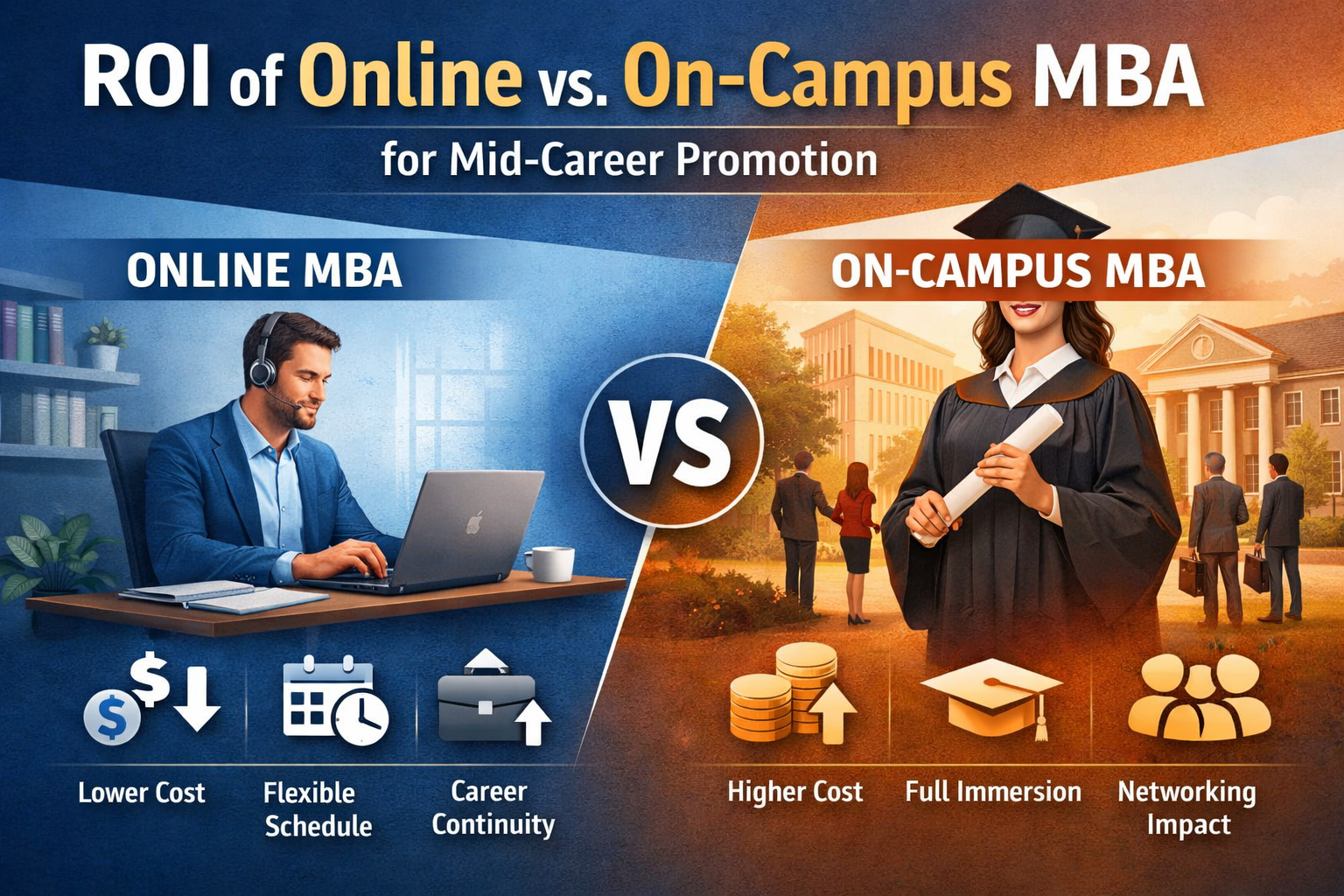
ROI of Online vs On-Campus MBA for Mid-Career Promotion
Your manager just got promoted. The position you’ve been eyeing for two years is finally posted. You’ve got the track record, the relationships, and the performance reviews to back you up. But the job description mentions “advanced business degree preferred,” and you’re wondering if now’s the time to pull the trigger on that MBA you’ve been researching.
Here’s the part nobody tells you upfront: the MBA format you choose matters less than how it fits into your current career momentum. I’ve watched colleagues take both paths, and the outcomes have almost nothing to do with whether they sat in a campus classroom or logged into Zoom from their home office.
The real difference shows up in whether they stayed visible at work during those two years. Whether they could apply what they learned before the promotion window closed. Whether stepping away hurt them more than the credential helped them.
The Math Everyone Gets Wrong
When people compare online versus on-campus MBA costs, they pull up tuition numbers and act like that’s the whole story. According to data from the Financial Times Global MBA Rankings, a top online program might run $60,000 to $80,000 total. A prestigious on-campus program could hit $150,000 to $200,000 or more. On paper, the online option looks like an obvious financial win.
Except that’s not how the real cost calculation works for someone already making $85,000 a year with benefits, a 401k match, and annual bonuses tied to performance. According to U.S. Bureau of Labor Statistics data, mid-career professionals in business and financial operations earn median salaries ranging from $75,000 to $95,000 annually. The bigger financial hit isn’t tuition. It’s what you give up by stepping away from work.
Going full-time on-campus means walking away from two years of salary. That’s $170,000 in lost income before you even factor in the missed retirement contributions, the bonus cycles you’re not participating in, and the salary increases you’re not getting. Add relocation costs if you’re moving for school, and you’re easily looking at a quarter-million dollar decision.
The online MBA lets you keep earning. You stay in the bonus pool. Your 401k keeps compounding. You don’t disrupt your financial trajectory, and if you’re navigating US workplace expectations after coming from overseas, staying employed might be critical for visa status too.
From a pure ROI standpoint, maintaining income continuity almost always wins unless you’re planning a complete career reset where the current income doesn’t matter anymore.
When Being Absent Actually Costs You the Promotion
Promotion committees have short memories. The work you did three years ago barely registers when they’re making decisions today. What matters is the last 12 to 18 months of contribution, leadership visibility, and what you’ve delivered recently.
If you leave for two years to do an on-campus MBA, you’re betting that the credential will outweigh the gap in recent performance memory. Sometimes that bet pays off, especially if you’re switching industries or functions entirely. But if you’re trying to move up within your current organization? That gap can be brutal.
I’ve seen this play out badly more than once. Someone leaves to get their MBA, comes back ready to level up, and discovers the promotion went to someone who stayed, delivered through the chaos, and became the trusted person everyone relied on while they were gone. The returning MBA grad has the degree, but the other person has the recent relationship capital and the fresh performance narrative.
Online programs let you stay in the game. You can take on stretch assignments while you’re studying. You can apply new frameworks to actual business problems in real time, which makes you more valuable, not less. You don’t disappear from leadership’s mental map of who’s ready for more responsibility.
That continuous visibility matters enormously when climbing the corporate ladder becomes about timing as much as credentials.
What Promotion Committees Actually Care About
Here’s what doesn’t come up in promotion discussions as often as people think: where you got your degree or whether you attended classes in person. What does come up constantly: can this person handle more complexity, do they manage ambiguity well, and will they perform under pressure at the next level.
Quick Comparison: Online vs On-Campus MBA for Mid-Career Professionals
| Factor | Online MBA | On-Campus MBA |
|---|---|---|
| Financial Cost | $60K-$80K tuition + $0 lost income = Lower total cost | $150K-$200K tuition + $170K+ lost income = Significantly higher |
| Career Visibility | Continuous presence, recent performance memory stays strong | 2-year gap, returning with credential but weaker recent track record |
| Network Type | Maintain existing work relationships + smaller peer cohort | New cohort network + weakened current relationships |
| Employer Support | Usually qualifies for tuition reimbursement ($10K-$25K/year) | Rarely covered by employer benefits |
| Promotion Timing | No delay, stay in annual cycles | Miss 4+ promotion windows over 2 years |
| Best For | Advancing in current track, need credential without disruption | Career pivot, industry switch, complete reset |
An online MBA signals something specific to evaluators. It shows you managed competing priorities, delivered while balancing a full workload, and stayed disciplined through a multi-year commitment. Those are exactly the traits that matter in senior roles where nobody’s going to hold your hand and the job is mostly about navigating ambiguity.
An on-campus MBA signals something different. It often suggests a career pivot, a conscious decision to step away and reset, or a willingness to take significant risk for long-term repositioning. That can be powerful if the story aligns with what the organization needs. But it can also introduce doubt if the committee is wondering whether you’re truly committed to staying or just using this role as a stepping stone after investing that much in a reset.
Neither signal is inherently better. But they’re read differently, and understanding that matters when you’re trying to position yourself for advancement. If you’re already on a clear path internally and the question is just about checking the credential box, staying put often makes more strategic sense. If you’re trying to break into a completely different function and need to rebuild your professional story from scratch, the immersive experience might be worth the career pause.
This kind of strategic thinking about career roadmap planning becomes critical when you’re making decisions that affect your next five to ten years.
The Employer Reimbursement Reality
Most people don’t realize how much employer tuition reimbursement changes the ROI equation. According to the Society for Human Resource Management (SHRM), approximately 56% of U.S. employers offer educational assistance programs. If your company offers education benefits, they’re almost always structured to support part-time, work-compatible programs. The policies are built around employees who stay employed while studying.
That usually means online or evening programs get full support, while full-time on-campus programs don’t qualify at all. And the difference isn’t trivial. Employer reimbursement can cover $10,000 to $25,000 per year, sometimes more at larger companies with robust development programs.
If you’re paying out of pocket for a $150,000 on-campus program, you’re carrying the full freight. If your employer is covering half of a $60,000 online program, your actual cost drops to $30,000. That changes the ROI math dramatically.
Beyond direct tuition coverage, there’s also the retention incentive component. Many companies require you to stay for a certain period after completing the degree, or you have to repay the benefit. That effectively locks in a couple more years of salary, bonus eligibility, and career progression that you wouldn’t have if you’d left for a full-time program.
For mid-career professionals already embedded in organizations with strong development cultures, walking away from employer support to self-fund an on-campus MBA can mean leaving $50,000 or more on the table. That’s a massive hidden cost that doesn’t show up in the sticker price comparison.
Cost Comparison Snapshot
| Cost Factor | Online MBA | On-Campus MBA |
|---|---|---|
| Tuition Range | Moderate | High |
| Income Disruption | Low | High |
| Relocation Costs | None | Common |
| Employer Sponsorship Fit | Strong | Limited |
| Financial Stability | Maintained | Interrupted |
When the On-Campus Path Actually Wins
There are absolutely scenarios where the on-campus MBA delivers better ROI despite the higher cost and career interruption. If you’re trying to break into investment banking, venture capital, or elite consulting, the on-campus recruiting pipeline and alumni network might be worth the investment. Those industries still heavily recruit from specific programs, and showing up on campus for recruiting season matters.
If you’re switching from a technical role into general management, or from operations into strategy, the immersive experience can help you make that pivot more credibly. The career services support, the in-person networking, and the focused time to rebuild your professional narrative all add value that’s harder to replicate in an online format.
And if you’re earlier in your career than true mid-career—say, three to five years out rather than seven to ten—the income opportunity cost is lower, and the positioning value of a strong on-campus program might outweigh the financial hit.
But here’s the critical nuance: those scenarios all involve some form of career discontinuity. You’re not trying to move up in your current track. You’re trying to jump tracks entirely. That’s when the reset makes sense.
For professionals who are already on the right career path and just need the credential to continue advancing, the online route usually delivers better ROI. You get the degree, you stay visible, you keep earning, and you position yourself for promotion without introducing unnecessary risk or gaps.
Much like aligning HR processes with financial goals requires understanding what actually drives business outcomes, picking the right MBA path requires understanding what actually drives promotion decisions in your specific context.
The Timing Factor Nobody Talks About
Promotion cycles are predictable. In most organizations, they happen annually or semi-annually. If you’re currently in the pipeline for advancement and you step away for two years, you’re missing four potential promotion windows. That delay compounds over your entire career.
Let’s say you’re 35, making $85,000, and positioned for a promotion to $110,000 in the next cycle. According to the Graduate Management Admission Council (GMAC) Corporate Recruiters Survey, MBA graduates in the U.S. see median starting salaries around $115,000, but the real value comes from accelerated advancement over time. If you leave for two years to do an on-campus MBA, you’re delaying that promotion until you’re 37. You’ve just pushed every subsequent promotion back by two years as well.
Now compare that to staying, getting promoted at 35, and completing an online MBA while working at the higher salary level. By 37, you’ve already banked two years at $110,000 plus bonuses, and you’re positioned for the next level up. The financial difference between those two paths isn’t just tuition. It’s cumulative career earnings over decades.
This timing dynamic is rarely included in ROI calculators, but it might be the single biggest factor for mid-career professionals. The opportunity cost of delayed advancement often exceeds the cost of the degree itself.
What Your Network Actually Needs
The networking argument for on-campus MBAs is real, but it’s often overstated for mid-career professionals. At this stage, your most valuable professional relationships are people who can advocate for you internally, refer you to roles, or collaborate on actual business problems. Those relationships overwhelmingly come from work, not from school.
An on-campus program gives you a cohort of classmates who are mostly in the same boat as you: early-to-mid career, looking to pivot or advance, geographically dispersed after graduation. Some of those connections will be valuable long-term. Many won’t.
An online program gives you a smaller peer network, but you’re also maintaining and deepening your existing work relationships the entire time you’re studying. You’re staying connected to the people who actually make promotion decisions, who control project assignments, and who will be your references when you’re ready to move.
For some people, especially those switching industries or relocating, the on-campus network makes sense. For professionals advancing within their current field, the work network you already have usually matters more.
There’s also the alumni network value question, which depends heavily on the specific programs you’re comparing. A top-tier online MBA from a respected school often carries similar alumni network benefits to their on-campus equivalent. The format matters less than the brand.
Making the Decision That Actually Fits Your Situation
The frustrating truth is that there’s no universal answer. The right choice depends entirely on where you are, where you’re trying to go, and what trade-offs you’re willing to accept.
If you’re on a clear promotion track, your company supports continuing education, and you need the credential without disrupting momentum, online almost always wins on ROI. If you’re trying to reset your career entirely, break into a new industry, or you’re at a natural career transition point anyway, on-campus might be worth the investment.
What doesn’t work is making the decision based on vague assumptions about prestige or format without thinking through the actual career mechanics. Mid-career professionals who succeed with MBAs—regardless of format—are the ones who treat the decision strategically rather than emotionally.
They look at their current trajectory, map out the promotion timeline, calculate the real financial impact including opportunity costs, and pick the path that supports their specific advancement goals. They don’t pick based on what sounds more impressive or what someone else did.
Because at the end of the day, the ROI of an MBA isn’t determined by the program. It’s determined by how well the program fits into your career strategy and whether it helps you get where you’re trying to go without introducing unnecessary setbacks along the way. That’s a more complex calculation than just comparing tuition costs, but it’s the only one that actually matters when you’re making a decision that will shape the next decade of your career.
From an ROI standpoint, preserving income and benefits often produces stronger long-term value than minimizing tuition alone.
Disclaimer: This article is for informational purposes only. Individual financial outcomes and career advancement depend on specific company policies, industry standards, and personal performance.

Karthick Raja is an MBA-qualified Finance & HR professional and founder of Business Tax Hub, with 10+ years of hands-on experience managing finance operations, taxation, payroll compliance, and HR functions. He helps students and professionals navigate the U.S. corporate landscape by translating real-world business experience into practical, job-ready career growth.