
How to List AI Skills on a Resume for Entry-Level Marketing Jobs

I was reviewing resumes last week for a marketing coordinator position, and out of 47 applications, 38 of them listed “AI tools” or “ChatGPT” in the skills section. Exactly three of those resumes explained what they actually did with those tools. The rest just dropped the buzzwords and hoped for the best.
Here’s what happened: the three who explained their usage got interviews. The other 35 went straight into the “too vague to evaluate” pile, regardless of how impressive their other qualifications looked. The difference wasn’t technical expertise. It was clarity about how AI supported actual marketing work.
If you’re trying to break into marketing right now, you’ve probably heard that AI skills matter. That’s true. But listing them wrong is worse than not listing them at all. Hiring managers can spot resume padding instantly, and in a stack of applications where everyone claims to use AI, the people who can show practical application are the ones who stand out.
How Do I Mention AI Skills in My Resume?
The biggest mistake people make is treating AI as a standalone skill category, like it’s equivalent to knowing Spanish or Excel. It’s not. AI is a tool that enhances how you do marketing tasks. That means it needs to be connected to those tasks, not floating in its own section like you’re applying for a machine learning engineering role.
According to research from LinkedIn’s Future of Work report, AI-related skills have seen 1,000% growth in demand since 2016, but what employers are actually looking for is “applied AI literacy”—the ability to use AI tools to accomplish business objectives, not technical mastery of the algorithms themselves.
When I’m scanning a resume, I want to see AI mentioned in context. That means weaving it into your experience bullets, not creating a separate “AI Skills” heading that lists tools with no explanation of what you did with them.
Resume Skill Mapping Example
| AI Capability | Weak Resume Language | Strong Resume Language |
|---|---|---|
| AI-assisted writing | “Proficient in ChatGPT” | “Used AI writing tools to draft and refine social media copy, improving consistency across 15+ weekly posts” |
| Campaign analytics | “Familiar with AI analytics” | “Reviewed AI-generated performance insights to identify underperforming ad variants and recommend budget adjustments” |
| Audience targeting | “Experience with AI segmentation” | “Applied AI-supported customer segmentation to group email audiences by engagement behavior, increasing open rates 12%” |
| Content optimization | “AI content creation” | “Tested AI-suggested headline variations and selected final versions based on brand voice and audience fit” |
Notice the pattern? The strong versions tell me what marketing problem you were solving and how AI helped you solve it. The weak versions just name-drop tools and leave me guessing whether you actually know how to apply them.
The American Marketing Association’s research on marketing skills shows that employers prioritize “AI-augmented critical thinking” over tool expertise. They want people who can use AI to work faster and smarter, not people who blindly trust whatever output the algorithm generates.
What Skills Do Entry-Level Marketing Jobs Need?
Entry-level marketing isn’t about leading strategy or running million-dollar campaigns. It’s about executing tasks that support bigger initiatives. That means the AI skills that matter most are the ones that help you do routine work better, faster, or with fewer errors.
The reality in most marketing departments is that AI is already baked into the tools everyone uses. Email platforms have AI-powered send-time optimization. Analytics dashboards surface AI-generated insights. Content management systems suggest SEO improvements automatically. You don’t need to be an AI expert to use these features. You just need to understand what they’re doing and when to trust them versus when to apply your own judgment.
Traditional vs AI-Enhanced Skill Comparison
| Core Marketing Skill | Without AI | With AI Support |
|---|---|---|
| Copywriting | Draft from scratch, multiple revisions | Use AI to generate first draft options, then edit for brand voice and accuracy |
| Market research | Manual competitor analysis, spreadsheet tracking | AI tools identify trends and patterns, you validate and contextualize findings |
| Performance reporting | Build reports manually from raw data | Review AI-generated summaries, flag anomalies, add strategic context |
| Customer segmentation | Sort data based on basic demographics | Interpret AI-driven behavioral segments, apply to campaign targeting |
| Content scheduling | Plan calendar based on gut feel or past patterns | Use AI recommendations for optimal timing, adjust based on brand priorities |
This comparison matters because it shows hiring managers that you understand AI as an accelerant, not a replacement. You’re not claiming AI does the work for you. You’re showing how it helps you do better work.
According to data from HubSpot’s State of Marketing Report, 64% of marketers already use AI in some capacity, but the ones who see the best results are those who combine AI efficiency with human oversight and strategic thinking. That’s exactly the mindset entry-level candidates need to demonstrate.
How to Write a Marketing Resume With No Experience?
This is where most entry-level candidates get stuck. You need experience to get hired, but you need to get hired to get experience. The good news is that hiring managers evaluating entry-level roles aren’t expecting years of professional work history. They’re looking for evidence that you understand how marketing works and that you can apply what you’ve learned.
AI skills actually give you an advantage here if you frame them right. You can demonstrate practical marketing capability through projects, coursework, or independent work that uses the same tools and processes professional marketers use daily.
Acceptable experience sources that translate well to resumes:
Academic projects: If you ran a simulated social media campaign for a class project and used AI tools to analyze engagement patterns or test content variations, that’s real applied experience. Frame it like a work project.
Volunteer work: Running social media for a campus organization, local nonprofit, or community group counts. If you used AI to schedule posts, analyze what’s working, or improve your writing, say so.
Personal projects: Building your own blog, YouTube channel, or social media presence and treating it like a marketing lab shows initiative. If you’re using AI to optimize content, track performance, or understand your audience, that demonstrates practical skills.
Freelance or side work: Even small paid projects—helping a friend’s small business with their Facebook ads, writing web copy for a startup, managing Instagram for a local shop—can be framed professionally if you can point to specific tasks and outcomes.
The key is describing this work the way you’d describe it internally at a company. Use action verbs, be specific about what you did, and connect it to results whenever possible.
Effective bullet structure for limited experience:
- Managed Instagram content calendar for [organization], using AI scheduling tools to identify optimal posting times and increase follower engagement by 23% over three months
- Analyzed email campaign performance data through AI-powered dashboard, identifying that Thursday morning sends generated 35% higher open rates than weekend sends
- Created blog content using AI writing assistants to generate initial drafts, then edited for SEO optimization and brand consistency across 12 published articles
These bullets work because they show workflow awareness. You’re not just saying you used AI. You’re showing how it fit into a process that delivered something measurable.
For more context on how to structure your professional story when you’re early in your career, understanding how to design a career roadmap can help you think strategically about positioning your experience.
Where Should AI Skills Appear on a Resume?
Placement matters more than people realize. Put AI skills in the wrong spot, and you risk looking like you’re trying too hard or don’t understand what the role actually requires.
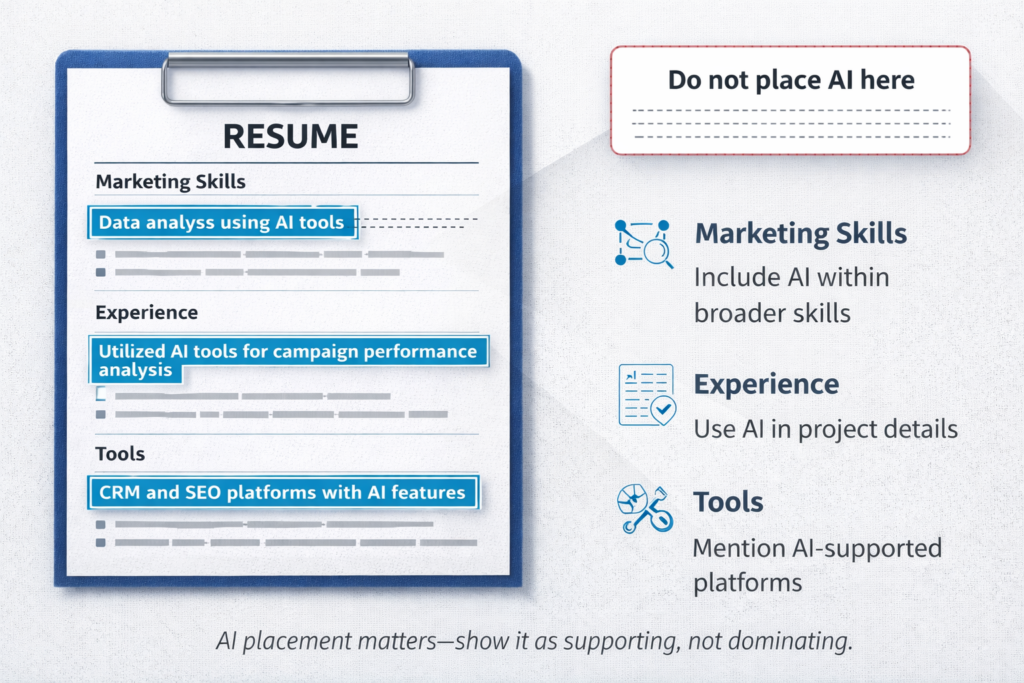
For entry-level marketing positions, AI capabilities should appear in three places, but with different levels of emphasis:
1. Skills section (brief mention): Include AI-related tools in your broader marketing skills list, but don’t make them the headline. Something like:
Marketing Skills: Content creation, social media management, email marketing, SEO basics, Google Analytics, AI-assisted content tools, campaign reporting
Notice AI is in there, but it’s not dominating. It’s one capability among several.
2. Experience bullets (detailed application): This is where AI skills actually matter. Every relevant work experience, project, or activity should include specific examples of how you used AI to support marketing tasks. This is your chance to show applied usage rather than just claiming familiarity.
3. Tools section (if you have one): Some resumes include a “Tools & Platforms” section. If yours does, you can list specific AI tools here, but again, keep it proportional:
Tools: HubSpot, Mailchimp, Canva, ChatGPT, Hootsuite, Google Analytics, Grammarly
What you want to avoid is creating a dedicated “AI Skills” or “Artificial Intelligence” heading that suggests you’re positioning yourself as an AI specialist. You’re not. You’re a marketer who knows how to use AI to work more effectively.
According to guidance from Indeed’s resume best practices, skills should be demonstrated through accomplishments, not just listed. That principle applies even more to emerging capabilities like AI, where everyone’s claiming proficiency but few can actually prove application.
How Do I Start an AI Career With No Experience?
If you’re reading “AI career” as “become an AI engineer or data scientist,” that’s the wrong framing for marketing roles. What you’re actually starting is a marketing career where AI literacy is part of your baseline toolkit, the same way email and social media are.
The barrier to entry is way lower than people think. You don’t need computer science courses or programming skills. You need to understand how AI features work in the marketing tools you’re already learning and practice using them responsibly.
Here’s a realistic path that doesn’t require going back to school or spending money on expensive certifications:
Learn the marketing fundamentals first: AI can’t fix bad marketing strategy. If you don’t understand audience targeting, messaging, or how to measure campaign success, AI tools won’t help you. Start with the basics—take free courses on content marketing, social media strategy, email marketing, SEO. Build that foundation.
Use AI-integrated tools for real projects: Most marketing platforms already have AI built in. Create a HubSpot account (they have a free tier), set up Mailchimp for a project, experiment with Canva’s AI features. You don’t need to hunt down specialized AI tools. Use the AI features in the tools marketers actually use.
Practice critical evaluation of AI outputs: This is the skill that separates people who understand AI from people who just use it blindly. When an AI tool suggests something—a headline, an audience segment, an optimal posting time—ask yourself: does this make sense? Does it align with what I know about the audience? Would a human marketer make this choice? Practice spotting when AI gets it right and when it needs human correction.
Document your learning with examples: Keep a portfolio of projects where you used AI tools and can explain your decision-making. Screenshots of before/after content, examples of how you refined AI-generated copy, notes on what worked and what didn’t. This becomes resume material and interview talking points.
The goal isn’t to become an AI expert. It’s to become a marketer who’s comfortable working alongside AI and knows when to lean on it versus when to override it.
For professionals looking to build broader workplace capabilities, developing effective communication skills is just as important as technical tool proficiency—maybe more so.
Common Resume Mistakes to Avoid
I see the same AI-related resume problems repeatedly. Here’s what kills your credibility:
Listing tools without context: “ChatGPT, Jasper, Copy.ai” tells me nothing. Did you use them once? Daily? For what purpose? With what results? Tool lists without application stories are meaningless.
Claiming expertise you don’t have: If you’ve played around with AI tools for a few class projects, you’re not “an AI marketing expert” or “proficient in machine learning applications.” Overstating your experience backfires during interviews when you can’t speak to it in depth.
Ignoring the human judgment piece: Resumes that make it sound like AI does all the work are red flags. “Used AI to create social media strategy” reads like you don’t actually know how to build strategy. “Used AI to generate content ideas, evaluated options against brand guidelines, and developed final strategy” reads like you understand the process.
Treating AI as more important than marketing fundamentals: If your resume emphasizes AI skills more heavily than core marketing capabilities—writing, analysis, project management, communication—you’re signaling wrong priorities. AI should enhance your marketing skills, not overshadow them.
Using jargon that doesn’t match the role: Entry-level marketing jobs don’t need you talking about neural networks, machine learning models, or algorithmic optimization. That language belongs in data science or engineering roles. Keep your AI descriptions grounded in marketing terms.
One pattern that works well: whenever you mention AI usage, also mention the human judgment you applied. That shows you understand the tool’s limitations and your role in the process.
How Hiring Managers Interpret AI Skills
From the recruiting side, here’s what I’m actually evaluating when I see AI mentioned on an entry-level marketing resume:
Can this person learn new systems quickly? Marketing tools change constantly. If you’ve figured out how to use AI features in one platform, you can probably adapt to new ones. That’s valuable.
Do they understand workflows? Using AI effectively requires knowing where it fits in a process. Can you describe not just what the tool did, but when you used it, why you chose it, and what you did with the output?
Will they need supervision on AI usage? Some candidates seem ready to blindly trust whatever AI generates. Others demonstrate critical thinking about when to use suggestions versus when to question them. The second group gets hired.
Are they overselling? Inflated claims about AI expertise are easy to spot and immediately tank credibility. Modest, specific descriptions of practical use come across as honest and professionally mature.
What I’m not evaluating: whether you know the latest AI tools, whether you can explain how the algorithms work, or whether you’re an AI enthusiast. None of that matters for an entry-level marketing role. What matters is whether you can use AI to do marketing work more effectively.
Understanding how digital skills complement traditional career development helps candidates position their capabilities in context rather than isolation.
The resume that gets traction isn’t the one claiming to be an “AI-powered marketing guru.” It’s the one that shows: I know how to write copy, analyze campaigns, manage social media, and track results. I also know how to use AI tools to do those things faster and better. That’s the message that lands.
When you frame AI skills as practical augmentation of core marketing capabilities rather than standalone technical expertise, your resume reads as credible, professional, and relevant to what entry-level marketing roles actually require.

Karthick Raja is an MBA-qualified Finance & HR professional and founder of Business Tax Hub, with 10+ years of hands-on experience managing finance operations, taxation, payroll compliance, and HR functions. He helps students and professionals navigate the U.S. corporate landscape by translating real-world business experience into practical, job-ready career growth.