Effective Email Communication in the Workplace: Why Most Professionals Get It Wrong

Email isn’t dead—despite what Slack evangelists might tell you. In U.S. corporate environments, email remains the most trusted communication channel for 79% of internal communications, according to recent data. Yet here’s what I’ve observed across a decade managing HR and finance operations: most professionals still treat email like casual texting, then wonder why projects stall, accountability disappears, and misunderstandings multiply.
The permanent nature of email is precisely what makes it both powerful and risky. When I managed payroll compliance for a mid-sized manufacturing firm, I watched a carelessly worded email about overtime calculations trigger a Department of Labor audit that cost us $47,000 in back wages and penalties. That email sat in someone’s inbox for 18 months before resurfacing during an employee complaint investigation—a reminder that every message you send creates a permanent corporate record with potential legal consequences.
What surprises people when they transition from academic life to corporate America is how email functions less as communication and more as documentation. It’s why understanding effective workplace communication strategies matters far beyond just “writing clearly.” You’re building evidence trails, establishing accountability, and sometimes—whether you realize it or not—creating the paper trail that protects (or implicates) your organization during compliance reviews.
When Email Communication Actually Breaks Down in U.S. Workplaces
Most articles tell you to “be clear and concise,” but that’s like telling someone to “just be good at their job.” The reality is messier. I’ve seen email communication fail in patterns that repeat across industries, and they rarely have anything to do with someone’s vocabulary or grammar skills.
Take the hybrid work environment many U.S. companies adopted post-2020. A project manager at a logistics company sent what she thought was a clear instruction: “Please prioritize the Q1 inventory reconciliation.” Sounds straightforward, right? Except three team members were in different time zones, “prioritize” meant different things to each person (does it mean today? this week? before the monthly close?), and nobody wanted to be the one to ask for clarification via email and look incompetent. The reconciliation happened three weeks late because everyone assumed someone else was handling the “priority.”
I made a similar mistake when managing a payroll implementation project across our East Coast and West Coast offices. I sent an email Friday afternoon saying “Let’s finalize the testing protocols before Monday.” My East Coast team stayed late Friday working on it. My West Coast team thought they had the weekend plus Monday morning. Meanwhile, I’d meant “have it done by Monday morning” but wrote “before Monday” which East Coast interpreted as “before Monday starts” and West Coast as “before Monday ends.” Monday’s kickoff meeting was a disaster—half the team had worked weekends unnecessarily, the other half showed up unprepared, and everyone was frustrated with each other. The fix? I now specify exact deadlines with time zones: “Complete testing protocols by Monday, March 18 at 9 AM ET.” Adding five extra words prevented hundreds of dollars in wasted effort and team friction.
This speaks to something deeper than poor writing—it’s about how email strips away the conversational repair mechanisms we rely on in person. You can’t read someone’s confused expression. You can’t immediately clarify. And in hierarchical corporate settings, people often won’t admit they don’t understand, especially upward in the organization chart.
Here’s what actually causes email failures in professional settings:
Accountability vanishes into vagueness. In U.S. business culture, there’s a politeness reflex that softens direct requests. “It would be great if we could get this done soon” doesn’t assign responsibility or set a deadline. Compare that to: “Jennifer, please complete the vendor payment reconciliation by Friday, March 15 at 3 PM ET and reply-all to confirm you’ve uploaded it to the shared drive.” One creates a paper trail of who’s responsible and when. The other creates confusion.
I learned this lesson during a particularly painful quarter-end close when I sent what I thought was a clear request to three finance analysts: “We need to finalize the accrual entries before Monday’s review.” I assumed everyone understood their responsibilities. Monday arrived, and only one person had completed their portion. The other two genuinely believed someone else was handling it because I hadn’t explicitly assigned ownership. We missed the executive review deadline, and I had to explain to our CFO why financials weren’t ready. That experience taught me to always name names and state deadlines explicitly, even when it feels unnecessarily direct. After implementing this approach—every email included a name, specific deliverable, and timestamp—our close cycle time dropped from 12 days to 7 days within two quarters, simply because accountability became unambiguous.
Tone misinterpretation escalates unnecessarily. A finance director once forwarded me an email from a department head that said simply: “I need the updated budget figures.” She was convinced he was angry with her. I checked with him—he’d written it while walking between meetings, hadn’t meant anything by the brevity. But she’d spent two days anxious about it and delayed sending the report. Emotional misreading of emails costs productivity in ways that don’t show up in any metrics.
I’ve had my own version of this. Early in my career, I sent an email to our HR director that started: “Per our conversation, here are the headcount projections.” She called me within 10 minutes asking if I was upset about something. I was genuinely confused—I’d just been trying to be efficient. She explained that “per our conversation” sounded formal and cold, like I was building a defensive paper trail. I hadn’t intended that at all, but the lack of context made it read that way. Now I add brief contextual phrases: “Following up on our discussion this morning, here are those headcount projections we talked about.”
The worst case I witnessed involved two managers who’d been collaborating fine for years. One sent an email that simply said: “We need to discuss the Johnson account.” The other interpreted this as criticism and responded defensively: “I’ve been managing Johnson exactly according to protocol.” That triggered a back-and-forth that escalated to HR within three days, all because the first manager had simply wanted to brainstorm expansion opportunities but hadn’t provided that context upfront. What should have been a 10-minute collaborative conversation became a documented workplace conflict requiring mediation. The lesson? Two extra sentences providing context (“I’ve been thinking about expansion opportunities with the Johnson account and wanted to get your thoughts on potential next steps”) would have prevented the entire mess.
The wrong communication channel gets used. I’ve watched email threads stretch to 47 messages because people were trying to resolve a complex disagreement in writing. Email is terrible for nuance, negotiation, or conflict resolution. The irony? Everyone involved knew a 15-minute call would solve it, but corporate norms around “getting it in writing” kept them hammering away at their keyboards. Understanding when delegation requires direct conversation versus email confirmation is a skill that separates effective managers from overwhelmed ones.
How U.S. Compliance Requirements Make Email Stakes Higher
Here’s something most workplace communication guides ignore entirely: in the United States, your emails aren’t just business communication—they’re legal documents subject to retention requirements, discovery in lawsuits, and regulatory scrutiny.
When you work in HR or handle any employment-related communication, federal law requires retaining certain emails for specific periods. Interview feedback? Three years for candidates not hired. Anything related to compensation, FMLA claims, or discrimination complaints? You’re looking at potentially six to seven years of retention requirements. I learned this the expensive way when our company faced an EEOC investigation and we had to produce two years of email communications between managers and a former employee. The casual way managers had discussed performance issues in email—using terms like “cultural fit” and “not a team player” without specific behavioral documentation—created significant legal exposure.
What made it worse was discovering that three different managers had deleted emails they thought were “just casual check-ins” about this employee. They didn’t realize that “casual” internal discussions about someone’s performance are exactly what investigators want to see. We ended up settling that case for considerably more than we should have, partly because the gaps in our email record looked suspicious. Since then, I’ve trained every manager I work with: treat every email about an employee as potentially discoverable in legal proceedings. That’s not paranoia—it’s understanding how employment law actually works.
This is particularly relevant as HR compliance requirements for 2026 continue expanding across state lines. California’s new automated decision-making technology rules, Delaware’s paid family leave documentation, and Illinois’s aggressive AI hiring regulations all have one thing in common: they require clear, documented communication trails. Your email habits aren’t just about etiquette—they’re about creating defensible records that hold up during audits.
For finance and operations roles, the stakes run through different regulations—SOX compliance for public companies, SEC retention requirements for broker-dealers, IRS documentation standards for tax positions. I once had to produce seven years of email correspondence about a specific revenue recognition decision because it came up during an audit. The documentation existed and was organized logically because we’d treated email as formal business records from day one. Other departments weren’t as fortunate.
I learned about retention requirements the hard way during my first year managing finance operations. Our IT department had implemented an auto-delete policy that purged emails older than two years to save server space. Nobody in finance flagged this as a problem—until an IRS audit requested documentation for an R&D tax credit claim from three years prior. The email thread where our tax consultant had explained the technical calculations?
Auto-deleted. The correspondence where department heads confirmed their teams’ eligible activities? Auto-deleted. We had some paper backup, but the email trail would have made the audit process much simpler. We spent $18,000 in additional consulting fees reconstructing information that had existed in our email system until IT helpfully “optimized” storage. After that incident, I worked with IT to create retention policies aligned with legal and regulatory requirements, not just technical convenience. Finance and HR emails now have separate retention rules—some categories kept for 7 years, others permanently.
What Actually Makes Workplace Email Effective: Real Implementation
Let me walk you through how this plays out in actual corporate scenarios, because the gap between “email best practices” and what works in practice is significant.
Scenario: Cross-departmental project with unclear ownership
When I led a cross-functional initiative to implement new payroll software, I inherited email chaos. Marketing thought IT was handling vendor selection. IT thought Finance owned the requirements gathering. Finance assumed HR would manage the timeline. Everyone was technically “involved” but nobody was accountable.
Here’s what changed: every project-related email specified exactly one person as DRI (Directly Responsible Individual) for each action item. Not “team should review this” but “Marcus (DRI): review security protocols by Thursday 3/14, forward findings to Laura.” Not “we need to finalize the contract” but “Jennifer (DRI): schedule legal review by Friday, copy me on the calendar invite.” This wasn’t about being controlling—it was about creating unambiguous paper trails that prevented the “I thought you were handling that” problem.
The DRI approach also solved the passive-aggressive CC problem where people copy half the company to spread blame preemptively. When accountability is explicit upfront, defensive copying decreases dramatically. I remember one manager who used to CC seven people on every email. After we implemented DRI assignments, his CC list dropped to two people on average—just those who actually needed to act or be informed. The noise level in everyone’s inbox decreased significantly.
Here’s a concrete example of how CC abuse wastes time: during one particularly chaotic product launch, our marketing team was copying 14 people on every single update email—some of whom had left the company months ago, others who had zero involvement in the project. I tracked it for one week: 43 emails, each averaging 6 people who didn’t need to be included. That’s 258 unnecessary emails landing in people’s inboxes in just five days. When I asked the marketing lead why, she said: “I don’t want anyone claiming they weren’t informed.” Classic CYA behavior that was killing everyone’s productivity. We fixed it by creating a shared project dashboard for informational updates and limiting email to only those who needed to act. Email volume dropped 60%, and people actually started reading the messages they received because they knew it was relevant to them. This connects directly to broader talent acquisition and organizational communication strategies that successful companies build into their operational culture.
Scenario: Remote team performance documentation
A manager in our remote sales organization needed to address consistent deadline misses with a team member. She’d been giving feedback verbally during Zoom calls, but nothing was improving. When it came time for a formal performance review, she had no documentation trail. We had to reconstruct timelines from chat logs and calendar notes, which looked sloppy in HR documentation.
The solution wasn’t “send more emails for the sake of documentation”—it was strategic follow-up. After every significant conversation about performance expectations, deadlines, or deliverables, send a brief summary email: “Following up on our discussion this morning about the Q2 sales report. To confirm: you’ll have the draft to me by Friday 3/15, we’ll review together on Monday 3/18, and the final version goes to leadership by Wednesday 3/20. Let me know if this timeline doesn’t work for your schedule.”
This isn’t micromanagement—it’s creating contemporaneous documentation that protects both the employee (they know exactly what’s expected) and the manager (there’s a clear record of communication and expectations). In U.S. employment law, contemporaneous documentation typically holds more weight than after-the-fact reconstructions. This practice has prevented countless wrongful termination claims.
I saw this play out when a sales rep claimed he’d never been told about specific performance expectations. His manager insisted they’d discussed it “multiple times” in their weekly Zoom calls. But without email follow-ups, it became a he-said-she-said situation. Meanwhile, another manager on the same team had documented identical conversations via brief follow-up emails. When her team member’s performance became an issue, she had six months of clear, dated records showing exactly what had been discussed and agreed upon. Guess which termination proceeded without legal challenge? Documentation isn’t about distrust—it’s about clarity and mutual protection.
Scenario: Budget approval chain during fiscal year-end
Here’s where email becomes genuinely strategic. During fiscal year-end close, our finance department processed hundreds of budget adjustments, each requiring multiple approvals. Early in my career, these happened via forwarded email chains where you’d see 12 “approve” replies with no clear audit trail of who approved what, when, with what understanding of the numbers.
We restructured the approval process to use structured email templates: clear subject lines with reference numbers (“Budget Adjustment #2026-0847: Marketing Software Increase – Approval Required”), standardized body text that showed exactly what was changing and why, specific deadline for response (“Please approve or request changes by 5 PM ET Thursday 3/14”), and required explicit confirmation text (“I approve this budget adjustment as presented” or “I request the following changes before approval”).
Suddenly, audit trails became clean, approvals happened faster because the cognitive load decreased (people knew exactly what they were approving), and we had defensible documentation when questions arose months later. This is where understanding how HR processes align with corporate financial goals becomes practically relevant in day-to-day communication.
The proof came during an internal audit six months later. Auditors requested documentation for a $180,000 budget reallocation that had happened during year-end chaos. With the old forwarding approach, we would have been scrambling to piece together who approved what. Instead, I pulled up a single email thread with timestamped, explicit approvals from our CFO, department head, and controller—each with the exact language they’d approved. The audit finding took 15 minutes instead of days of reconstruction work. The auditor actually commented that our documentation was the cleanest they’d seen. That’s when I realized proper email structure isn’t bureaucracy—it’s operational efficiency.
The Compliance-Communication Connection Most Professionals Miss
Let me address something that doesn’t get discussed enough in typical “email etiquette” articles: the intersection between communication effectiveness and legal compliance. In my experience managing both HR and finance functions, this intersection is where most organizations create unintentional risk.
Consider accommodation requests under the ADA. When an employee sends an email asking for a schedule adjustment because of a medical condition, that’s not just a scheduling request—it’s potentially triggered a legal obligation under federal disability law. How managers respond, what they ask (and don’t ask), and how they document the interactive process all happens via email. I’ve seen well-meaning managers create legal exposure simply because they didn’t understand that certain questions about medical conditions shouldn’t be asked via email (or at all), while other documentation is legally required.
The ADA accommodations process requires specific documentation, interactive dialogue, and careful communication—all typically happening via email in modern workplaces. Managers need to understand not just “communication best practices” but compliance implications of what they write. This training gap is massive in most organizations.
I once had to intervene when a department head responded to an accommodation request by asking via email: “What exactly is your medical condition?” and “How long will you need this accommodation?” Both questions violated ADA guidelines. The appropriate response would have been: “Thank you for bringing this to my attention. I’ll connect you with HR to begin the interactive process and discuss what accommodations might be appropriate.” The difference seems subtle, but one approach documents compliance with federal law while the other creates a potential discrimination claim. That manager meant well—he just didn’t know the rules. His email sat in the employee’s inbox as evidence of an improper inquiry for two years before it became relevant during a later dispute about a different matter entirely. Old emails have a way of resurfacing at inconvenient times.
Similarly, when dealing with FMLA requests, wage and hour questions, or workplace safety concerns, your email communication isn’t just business discussion—you’re creating the evidentiary record that will be examined if these issues escalate to formal complaints or lawsuits. The DOL and EEOC regularly request email correspondence during investigations. What seemed like a casual exchange about overtime calculations can become exhibit A in a wage claim.
I experienced this firsthand when a vendor disputed a $23,000 payment, claiming we’d agreed to different terms. Their account manager forwarded an email thread from eight months earlier where our procurement manager had written: “Sounds good, let’s move forward with that.” The problem? “That” referred to a pricing structure discussed in a phone call that neither party had documented in writing. We ended up paying an additional $8,500 to settle the dispute because we couldn’t prove what “that” actually meant. The vendor’s written proposal (which we’d never formally rejected in writing) became the binding terms. One vague email cost us nearly 40% more than we’d budgeted. Now I require every pricing agreement, scope change, or contractual commitment to be explicitly stated in the email body—not referenced with pronouns pointing to undocumented conversations.
This is why I emphasize treating email as formal business communication even when it feels conversational. You’re not being paranoid—you’re recognizing reality. The organizational memory lives in email archives, and regulators know it.
Building an Email Communication Approach That Actually Works
Based on a decade of seeing what breaks (and what holds up), here’s the framework that works in actual corporate practice:
Before writing any email, identify its primary function: Are you documenting a decision, requesting action, sharing information, confirming understanding, or escalating an issue? Each function requires different structure and tone. Documentation emails need precision and context. Action requests need clarity and deadlines. Information sharing needs organization and relevance. This sounds basic but most email problems stem from mixing functions—trying to simultaneously document, request action, and share information in one overcrowded message.
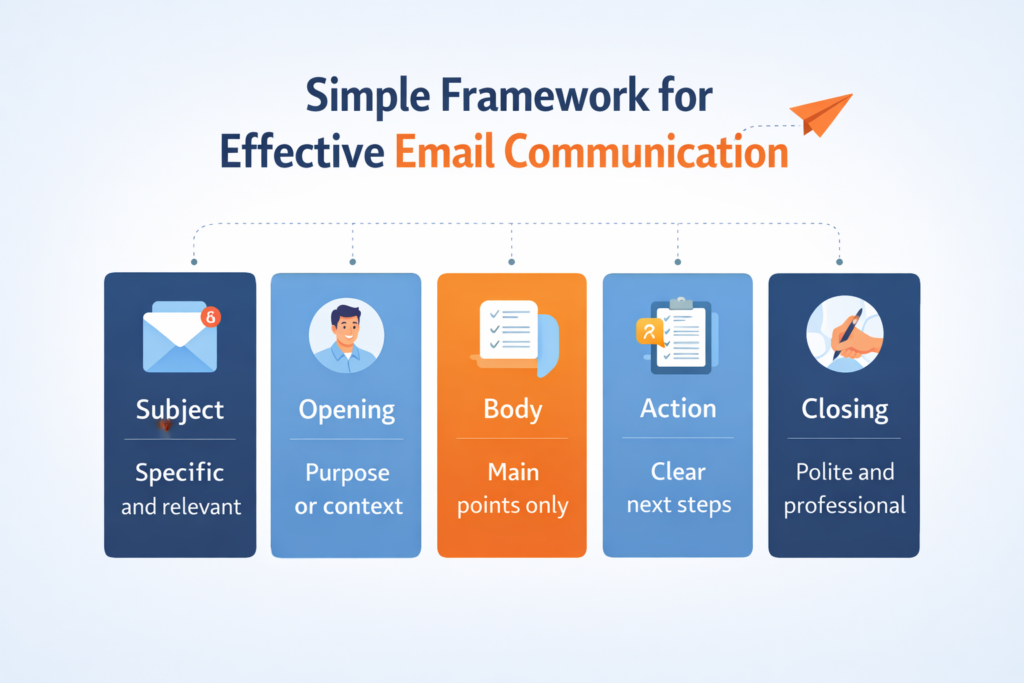
Structure matters more than style: I don’t care if you start with “Hope this finds you well” or jump straight to business. What matters is whether your email answers the five key questions: What do you need? From whom? By when? What happens next? Who should be informed? Clear structure reduces back-and-forth, which is where email communication typically degrades. Every additional round of “just to clarify…” messages increases the chance of misunderstanding and weakens accountability.
Know when email is the wrong tool: Complex conflicts, sensitive feedback, nuanced negotiation, bad news that affects people’s jobs or livelihood—these warrant real-time conversation. Email those things afterward to document what was decided and next steps, but don’t try to handle the substance via keyboard. I’ve never seen a termination discussion, serious performance issue, or team conflict resolved well through email. Ever. The managers who try usually regret it when HR reviews the email trail later.
Build in confirmation loops for critical communication: For high-stakes messages—project deadlines, policy changes, compliance requirements, budget approvals—always include a confirmation request: “Please reply by Thursday confirming you’ve read this and understand the new overtime approval process.” Don’t assume silence equals understanding. In corporate America, silence often means the email got buried in someone’s overflowing inbox and they never saw it. Confirmation creates accountability on both sides.
Remember your audience’s context: The executive checking email between board meetings needs different communication than your peer who shares your technical knowledge. Your international colleague working in a second language needs clearer structure than native English speakers. Remote employees need more explicit context than people in the office who overhear adjacent conversations. Good email communication adjusts to these realities rather than sending everyone the same message style.
I learned this lesson when working with our Indian finance team on month-end reconciliations. I’d send emails saying things like “Can you wrap up the AP reconciliation by Thursday?” In American corporate culture, “can you” is understood as a polite directive. My colleagues in Bangalore interpreted it as asking if they had the capacity, not as an assignment. They’d respond “Yes, we can do that” and then wait for me to formally assign it. After weeks of confusion and missed deadlines, one of them finally explained: “When you ask ‘can you,’ we think you’re checking availability. If you need it done, just say ‘please complete the AP reconciliation by Thursday.'” That small wording change eliminated an entire category of miscommunication. Now when I work across cultures or with ESL speakers, I use direct language without American softening hedges. Not because I’m being harsh—because clarity serves everyone better than culturally specific politeness conventions that create ambiguity.
What This Looks Like in Your Daily Work
Here’s the practical application: tomorrow morning, before you send your first email, pause and ask whether this message would hold up if scrutinized six months from now during an audit, investigation, or legal review. That’s not about fear—it’s about professionalism. Would someone reading this cold understand the context, the request, the timeline, and the accountability?
If you manage people, your email habits set the team standard. If you’re early in your career, developing strong email discipline now prevents the scattered communication patterns I see in many mid-career professionals who never learned to document effectively. This skill becomes increasingly important as you progress into roles with broader responsibility.
For those developing their career trajectory, understanding how soft skills like communication bridge technical expertise is what separates competent professionals from those who advance into leadership. Email communication is where this plays out daily.
The professionals who excel at workplace email aren’t necessarily the best writers—they’re the ones who understand that email serves documentation, accountability, and compliance functions that extend far beyond the immediate message. They recognize that every email contributes to or detracts from their professional reputation. And they know that in corporate America, what’s in writing matters more than what was said in meetings.
My Line: Effective email communication isn’t about following rules—it’s about understanding that in modern U.S. workplaces, how you write shapes how you’re perceived, determines what can be proven later, and influences whether projects succeed or stall. Treat it accordingly.
I’ll be honest: when I started my career, I thought people who obsessed over email documentation were being unnecessarily formal. I learned differently when I watched a colleague get blamed for a project failure because he couldn’t prove he’d sent clear instructions three months earlier. He insisted he’d communicated the requirements. The project manager insisted she’d never received them. No email trail meant no evidence either way. My colleague’s reputation took a hit that affected his next promotion cycle. Meanwhile, another team lead who documented everything via structured email follow-ups had a spotless track record—not because his projects went more smoothly, but because when issues arose, he could show exactly what had been communicated, when, and to whom.
That experience taught me that email isn’t just communication—it’s professional insurance. The time you invest in clear, documented, compliant email habits pays dividends you can’t always predict. Sometimes it’s avoiding a Department of Labor penalty. Sometimes it’s proving you did your job when someone claims you didn’t. Sometimes it’s simply moving projects forward efficiently because everyone knows exactly what’s expected. The common thread? Taking email seriously as a professional skill, not just a casual workplace activity.

Karthick Raja is an MBA-qualified Finance & HR professional and founder of Business Tax Hub, with 10+ years of hands-on experience managing finance operations, taxation, payroll compliance, and HR functions. He helps students and professionals navigate the U.S. corporate landscape by translating real-world business experience into practical, job-ready career growth.