
How HR Analytics Improves Financial Performance in Mid-Sized Companies

The CFO walked into my office last quarter with a question I wasn’t expecting: “Why are we spending 18% more on recruiting than we budgeted, and why is productivity down in operations despite adding three new hires?”
She had the financial data. I had the HR data. But neither of us had connected the dots until that moment. Turns out, we had a manager in operations who’d burned through five employees in eight months. High turnover was driving up recruiting costs while new hires couldn’t get up to speed fast enough because nobody stayed long enough to train them properly. The financial impact was showing up in the P&L, but the root cause was buried in HR metrics we weren’t actively monitoring.
That conversation changed how we approached people data. HR analytics stopped being something we talked about at conferences and became the thing that helped us find money we were bleeding without realizing it.
Why Most Companies Get HR Analytics Wrong
Here’s the uncomfortable truth: most mid-sized companies collect tons of HR data and do almost nothing useful with it. They’ve got applicant tracking systems, HRIS platforms, payroll software, and performance management tools all generating reports. And most of that reporting sits in folders nobody opens unless there’s an audit or a lawsuit.
The problem isn’t lack of data. It’s that HR teams are producing metrics that don’t answer questions leadership actually cares about. Total training hours completed? Number of performance reviews submitted on time? Employee satisfaction survey response rates? None of that tells you whether you’re about to blow your labor budget or whether your workforce can actually execute on next quarter’s revenue targets.
According to research from Deloitte’s Human Capital Trends report, while 71% of companies consider people analytics a priority, only 9% believe they have a good understanding of which talent dimensions drive performance. The gap between intention and execution is massive, and it shows up in how companies make decisions about their largest expense: people.
What actually works is treating HR analytics the way finance treats financial reporting. You don’t produce reports because you’re supposed to. You produce them because someone needs to make a decision, and they need data to make it well.
The Metrics That Actually Matter When Margins Are Tight
When I’m working with leadership teams trying to figure out where HR analytics can help, I start with a simple filter: does this metric help us understand cost, risk, or growth? If the answer is no, it doesn’t belong in an executive dashboard.
HR Metrics That Move Financial Outcomes
| Metric | What It Reveals | Financial Impact | Action Trigger |
|---|---|---|---|
| Voluntary Turnover Rate | Who’s leaving and why | Recruiting costs can spike 50-200% of salary per replacement | Above 15% annually in critical roles |
| Time-to-Fill | How long positions stay open | Lost productivity + overtime costs for remaining team | Over 45 days for standard roles |
| Revenue per Employee | Workforce productivity output | Direct margin impact and scaling capacity | Declining trend over 2+ quarters |
| Absenteeism Rate | Early burnout signals | Productivity loss + coverage costs | Above 3% unplanned absence |
| Labor Cost Ratio | Total people costs vs. revenue | Budget sustainability and competitiveness | Above industry benchmark +15% |
These aren’t academic metrics. They’re the ones that show up in actual finance reviews when leadership is trying to understand why profitability isn’t matching the forecast.
According to Society for Human Resource Management (SHRM) research, the average cost to replace an employee is between six to nine months of their salary. For a mid-sized company losing 20 people a year at an average salary of $65,000, that’s potentially $650,000 to $975,000 in replacement costs alone. That doesn’t count the productivity loss, the knowledge drain, or the impact on team morale.
When you frame HR analytics around those kinds of numbers, it stops being an HR initiative and becomes a business priority.
Where the Money Actually Leaks
The biggest value I’ve seen from HR analytics isn’t in optimizing what’s already working. It’s in finding expensive problems that nobody realized were connected.
High turnover in a single department usually isn’t a compensation problem. It’s a management problem. But if you’re only looking at exit interview data or aggregate turnover rates, you miss it. When you start tracking turnover by manager, by tenure, and by performance rating, patterns emerge fast.
Extended time-to-fill does more damage than most people realize. Every week a revenue-generating position sits open, you’re losing output. The team that’s covering is working overtime, which costs more and burns people out faster. The work that doesn’t get done creates delays downstream. And when you finally hire someone, they’re walking into a stressed team that doesn’t have time to train them properly, so their ramp time is longer than it should be.
One manufacturing company I worked with was tracking time-to-fill at 62 days on average. They thought that was reasonable given their location and the roles they were hiring for. When we dug into the data, we found that first-round interview scheduling was taking 18 days on average because hiring managers weren’t making themselves available. That wasn’t a talent market problem. That was a process problem that was costing them two and a half weeks per hire for no reason.
Pay compression is another one that hides until it explodes. You hire someone new at market rate, but your existing team hasn’t gotten raises that keep pace. The new hire is making more than people who’ve been there three years. Nobody says anything for a while, but the resentment builds. Then you lose two good people in the same month, and when you ask why they’re leaving, it’s always “better opportunity.” The real reason is they finally looked at what they could make elsewhere and realized they were underpaid.
These problems don’t show up in quarterly HR reports about headcount or diversity metrics. They show up when you connect workforce data to financial outcomes and start asking better questions.
The Integration Problem Nobody Wants to Talk About
Most mid-sized companies have a Frankenstein setup when it comes to HR and finance systems. Payroll is in one system. Benefits are in another. Time tracking is somewhere else. Performance data lives in a separate platform. And finance is running their own reports in the ERP that may or may not align with what HR is tracking.
Getting these systems to talk to each other is expensive and complicated. The integration projects that promise to solve this often run over budget and under-deliver. I’ve seen companies spend six figures on implementations that technically work but don’t actually make decision-making any easier.
From Fragmented to Functional: Data Integration Reality Check
| Challenge | Typical Broken State | What Actually Works |
|---|---|---|
| HR + Finance Alignment | Separate reports, different definitions | Shared metrics with single source of truth |
| Real-time Workforce Costs | Week+ delay between payroll and finance close | Daily labor cost visibility in unified dashboard |
| Compliance Reporting | Manual data pulls, spreadsheet gymnastics | Automated audit trails with timestamp validation |
| Executive Decision Speed | Request data → wait 3 days → get outdated answer | Self-service dashboards with current-state access |
| System ROI Justification | “We think it’s helping” | Measurable time savings + cost avoidance |
The solution isn’t always better technology. Sometimes it’s just cleaner data definitions and a shared commitment between HR and finance to use the same numbers.
Understanding workplace strategy includes recognizing that data infrastructure is part of operational design, not just an IT problem.
How This Actually Reduces Risk and Audit Headaches
Here’s a benefit of HR analytics that doesn’t get talked about enough: it makes compliance and audit preparation dramatically less painful.
When your reporting is standardized and automated, you’re not scrambling to pull data when a government agency comes asking questions. You’re not trying to reconstruct historical headcount or prove you paid people correctly three years ago. The data is already there, already organized, already defensible.
According to the U.S. Department of Labor Wage and Hour Division, wage and hour violations cost employers hundreds of millions in settlements annually. Many of these violations aren’t intentional. They’re tracking errors, classification mistakes, or overtime calculation problems that stem from poor data management.
HR analytics that ties directly to payroll and time tracking creates an audit trail that protects the organization. It also surfaces potential compliance issues before they become violations. If your analytics show that certain employees are consistently working just under the overtime threshold, that might be fine. Or it might be that managers are playing games with scheduling to avoid overtime costs, which creates legal risk and signals a deeper cultural problem.
Classification issues are another huge exposure area. According to recent analysis from the Society for Human Resource Management, employee misclassification costs organizations an average of $3,000 per misclassified worker in back wages and penalties, not counting legal fees or reputational damage.
When you’re tracking contractor spend, hours worked, and role responsibilities through analytics, misclassification patterns become visible before they become lawsuits.
The Retention and Productivity Connection
Employee engagement surveys are popular, but they’re backward-looking and subjective. By the time someone’s survey responses show disengagement, they’re often already job searching.
Better early warning signals come from behavioral data. Absenteeism patterns, especially unplanned absences, spike before turnover. Declining internal mobility or people turning down development opportunities signal disengagement before it shows up in survey responses.
When you track these indicators and act on them, you can intervene earlier. That might mean having a conversation with a manager about workload distribution. It might mean addressing a toxic team dynamic. It might mean recognizing that someone’s ready for a new challenge before they start looking externally.
The Gallup State of the Global Workplace report found that actively disengaged employees cost the world $8.8 trillion in lost productivity, representing 9% of global GDP. While that’s a macro statistic, the micro version plays out in every mid-sized company: disengaged employees produce less, make more mistakes, and drag down team performance.
The financial impact of engagement isn’t abstract. It shows up in output per employee, in quality metrics, in customer satisfaction scores, and eventually in revenue. HR analytics that tracks engagement drivers alongside performance and productivity metrics gives you the ability to manage that connection actively rather than reactively.
What Leadership Actually Needs From HR Analytics
The executives I work with don’t want more data. They want answers to specific questions:
- Are we going to hit our hiring plan, or are we going to miss revenue targets because we can’t staff fast enough?
- Is our compensation competitive enough to retain key people, or are we about to lose talent we can’t afford to replace?
- Are we getting productivity improvements from the people investments we made last year, or did we just add cost?
- What’s our real exposure on compliance and classification issues if we get audited?
These are strategic questions with financial implications. HR analytics earns a seat at the leadership table when it can answer them with data rather than opinions.
One practical approach that works is building simple executive dashboards that focus on decision support rather than data dumps. Five to seven key metrics, updated monthly, with trend lines and variance to plan. When something’s off track, the dashboard flags it and provides enough context to start a meaningful conversation.
This isn’t about producing perfect predictive models or hiring data scientists. It’s about making workforce data accessible and relevant to the people who make resource allocation decisions.
Getting Started Without Overcomplicating It
The companies that succeed with HR analytics don’t start by trying to build a comprehensive people analytics function. They start by picking one or two high-impact problems and using data to solve them.
Maybe it’s turnover in a critical department that’s killing productivity. Maybe it’s time-to-fill that’s creating bottlenecks in growth plans. Maybe it’s labor cost variance that’s blowing up budget forecasts.
Pick the problem that’s causing the most pain, identify the data you’d need to understand it better, and build the minimum viable reporting to make better decisions. Then expand from there.
A useful framework for mid-sized companies:
Phase 1: Fix the obvious leaks
- Track turnover by department and manager
- Monitor time-to-fill for revenue-critical roles
- Calculate actual labor cost ratio against budget
Phase 2: Connect to financial outcomes
- Link turnover costs to recruiting budget variance
- Correlate productivity metrics with revenue per employee
- Track compliance exposure through classification audits
Phase 3: Enable predictive action
- Identify early warning indicators for attrition risk
- Build workforce planning scenarios tied to growth forecasts
- Create manager scorecards that connect people metrics to business results
The goal isn’t sophistication. It’s usefulness. HR analytics works when it changes decisions. When leadership uses the data to allocate resources differently, address problems faster, or avoid risks they wouldn’t have seen coming.
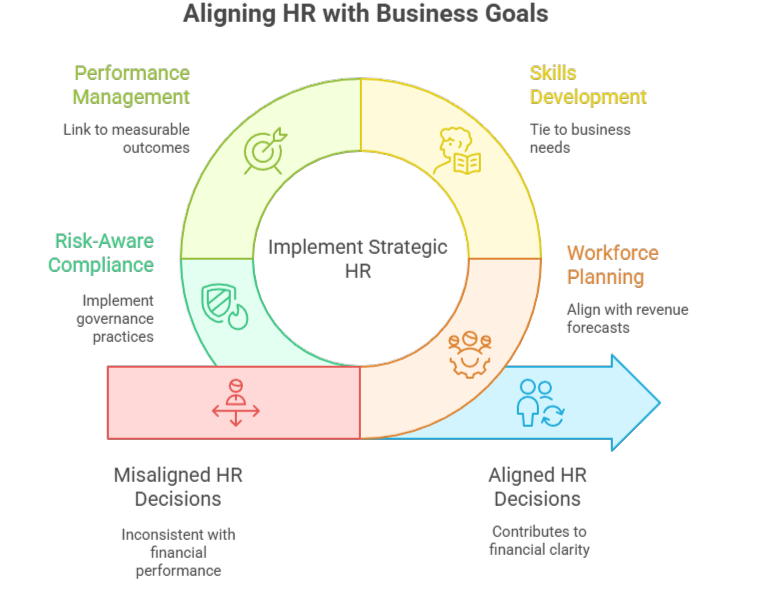
For organizations serious about aligning HR processes with corporate financial goals, analytics becomes the bridge between people strategy and business outcomes. It’s how you prove that investments in people drive returns, and how you demonstrate that HR isn’t just a cost center managing compliance—it’s a function that directly impacts profitability, growth, and sustainability.
When finance and HR speak the same language, backed by the same data, the quality of decision-making improves across the entire organization. That’s where the real value of HR analytics lives.
Disclaimer: The information on this website is for educational purposes only and does not constitute professional financial or legal advice

Karthick Raja is an MBA-qualified Finance & HR professional and founder of Business Tax Hub, with 10+ years of hands-on experience managing finance operations, taxation, payroll compliance, and HR functions. He helps students and professionals navigate the U.S. corporate landscape by translating real-world business experience into practical, job-ready career growth.