
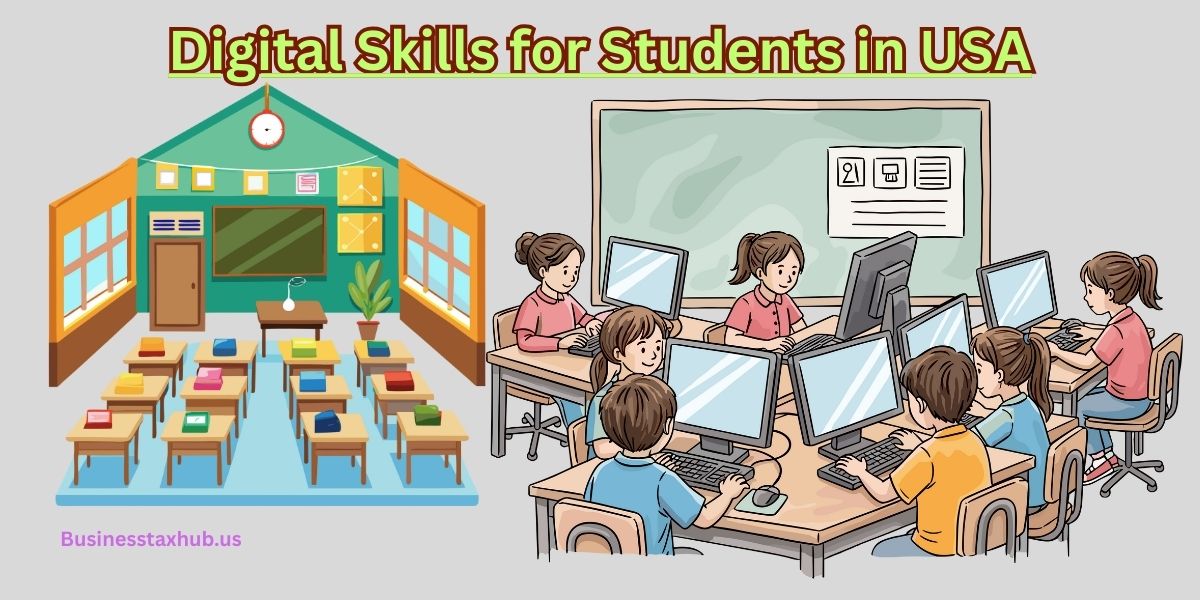
Digital Skills for Students in USA
When people talk about digital skills for students in the USA, it can sometimes sound vague or abstract, like a buzzword that means everything and nothing at the same time. But for students sitting in classrooms, juggling assignments, part-time jobs, and future plans, digital skills are very real.
They show up when a homework file won’t upload, when a group project falls apart because no one knows how to collaborate online, or when a student realizes too late that “being good with phones” isn’t the same as being digitally prepared for college or a career. This article takes a problem-solving approach because the challenge isn’t a lack of technology.
Schools are full of devices, apps, and platforms. The real issue is helping students develop practical, transferable digital skills they can actually use in school, work, and everyday life. The first challenge many educators and parents notice appears as early as high school. Students are surrounded by technology, yet many struggle with basic digital tasks.
Digital skills for high school students go far beyond social media and entertainment. High schoolers are expected to research credible sources, manage multiple online platforms, submit assignments digitally, and communicate professionally with teachers. Still, it’s common to see students copy unreliable information from the first search result they find or lose grades because they don’t understand file formats, version control, or digital organization. This is where digital literacy skills for students become essential.
Digital literacy is not just knowing how to use tools, but understanding how information works online. A digitally literate student knows how to evaluate whether a website is trustworthy, understands how algorithms influence what they see, and can recognize misinformation before spreading it.
These skills directly affect academic performance. A student who knows how to search effectively, cross-check sources, and manage digital notes will work faster, feel less overwhelmed, and produce stronger work.
As students move closer to graduation, the stakes get higher. Digital skills for college and career readiness are no longer optional. Colleges expect students to navigate learning management systems, collaborate through shared documents, participate in virtual discussions, and manage deadlines independently.
Employers expect even more. Entry-level jobs often require familiarity with spreadsheets, email etiquette, cloud tools, and basic data handling. Students who lack these skills may be smart and motivated, yet still fall behind peers who are more digitally prepared.
This leads to an important question many students ask, sometimes out loud and sometimes quietly: why students should be digitally literate in the first place.
The answer is simple but powerful. Digital literacy gives students control. It allows them to learn independently, solve problems efficiently, and adapt when tools change. Technology will continue to evolve, but the ability to learn new platforms, troubleshoot issues, and think critically online is what lasts.
At the core of this conversation are foundational digital literacy skills. These are the building blocks students rely on every day, even if they don’t realize it.
Foundational skills include understanding how devices and operating systems work, managing files and folders, using productivity software, navigating the internet safely, and communicating clearly through digital channels. Without these basics, more advanced skills feel intimidating and out of reach.
Educators often summarize these ideas into what are commonly referred to as the 5 basic digital skills. While phrasing may vary, they usually include information literacy, communication, collaboration, content creation, and digital safety. Information literacy helps students find and evaluate data.
Communication covers email, messaging, and virtual presentation skills.
Collaboration involves working with others using shared tools. Content creation includes writing, presentations, and basic media production. Digital safety ensures students protect their privacy, security, and well-being online. To make this more concrete, it helps to look at digital skills examples students encounter daily.
A student creating a well-formatted Google Doc with citations is practicing content creation and information literacy. Another student organizing a group project in a shared folder and assigning tasks through a collaboration tool is building teamwork and project management skills.
A student who recognizes a phishing email and avoids clicking suspicious links is demonstrating digital safety. These moments may seem small, but together they shape long-term competence.
Understanding the importance of digital skills for students also means recognizing how uneven access and instruction can be. Some students learn these skills at home through exposure and guidance, while others rely entirely on school. When digital skills are not taught intentionally, gaps widen.
Students who struggle may internalize the problem, assuming they are “bad with technology,” when in reality they were never shown how to use it effectively.
This is why structured initiatives like Applied Digital Skills programs matter. These programs focus on practical, real-world tasks rather than abstract theory. Students learn by doing, whether that means creating a budget spreadsheet, designing a presentation for a real audience, or managing a simple project from start to finish. The emphasis is on transferable skills students can use immediately and build on over time.
When we step back, the broader value of digital literacy becomes clear through the 5 key importance areas of digital skills. Digital skills support academic success by making learning more efficient and independent. They improve employability by aligning student abilities with workplace expectations.
They promote equity by giving all students access to essential tools and knowledge. They strengthen critical thinking by teaching students to question and evaluate online information. Finally, they empower lifelong learning by helping students adapt as technology changes.
For students wondering where to start, the best advice is to focus on practical habits rather than mastering every tool at once. Organizing digital files, learning keyboard shortcuts, practicing professional communication, and questioning online information are small steps with big returns.
For educators and parents, the solution lies in treating digital skills as core life skills, not optional add-ons. Conversations, modeling, and guided practice matter just as much as access to devices.
Digital skills for students in the USA are about readiness, confidence, and opportunity. When students understand not just how to use technology, but how to think critically and responsibly within digital spaces, they are better prepared for school, work, and the unpredictable challenges ahead. Digital literacy doesn’t just help students keep up. It helps them move forward with purpose.

Karthick Raja is an MBA-qualified Finance & HR professional and founder of Business Tax Hub, with 10+ years of hands-on experience managing finance operations, taxation, payroll compliance, and HR functions. He helps students and professionals navigate the U.S. corporate landscape by translating real-world business experience into practical, job-ready career growth.