
How to Write a SWOT Analysis on Yourself
You’re three years into your current role, and something feels off. Not wrong exactly, but stagnant. Maybe a recruiter reached out last week with an opportunity that sounded exciting, but you froze when they asked about your core strengths. Or perhaps you’ve been eyeing a promotion, yet you can’t articulate why you deserve it. Sound familiar?
Here’s the thing most career advice won’t tell you: the biggest obstacle to professional growth isn’t lack of opportunity—it’s lack of clarity about who you actually are in the workplace. And that’s where a personal SWOT analysis becomes less of a business school exercise and more of a career survival tool.
I’ve watched countless professionals stumble through career transitions because they never took the time to understand their own landscape. They know they’re “good with people” or “detail-oriented,” but when pressed for specifics, they default to LinkedIn buzzwords that mean absolutely nothing. A proper personal SWOT analysis forces you past the platitudes into territory that’s uncomfortable but invaluable. In this article will see How to Write a SWOT Analysis on Yourself
What Actually Happens When You Map Your Professional Reality
Think of a SWOT analysis as taking inventory before a major trip. You wouldn’t pack for a month in Southeast Asia without checking what you already own, what’s broken, what new gear you need, and what obstacles you might face. Yet people make massive career decisions—switching industries, negotiating salaries, starting businesses—without this basic reconnaissance.
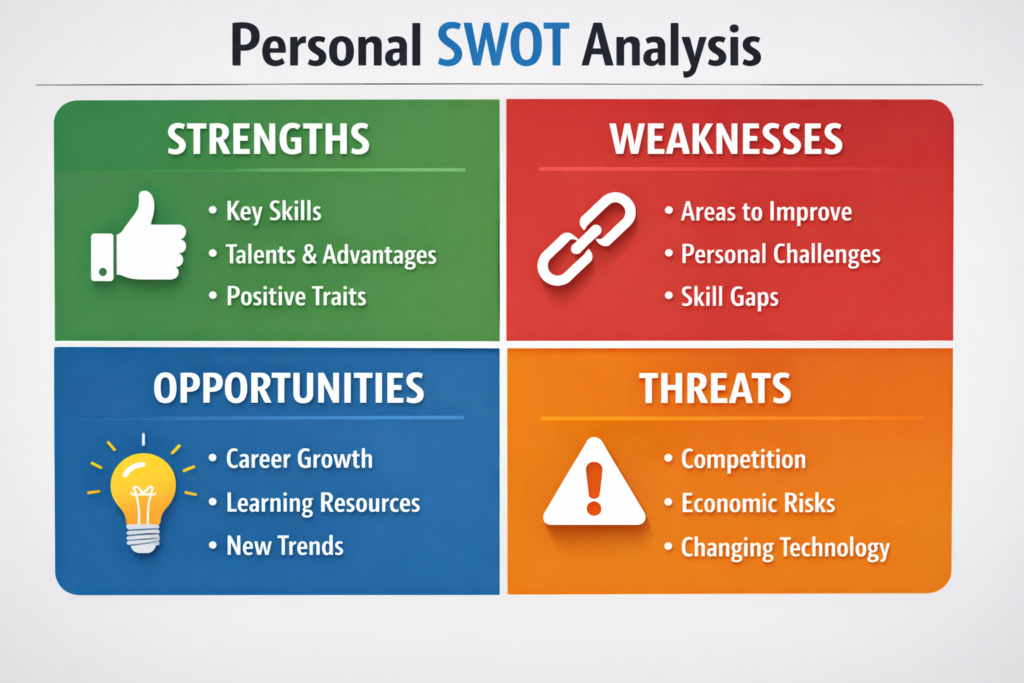
The framework itself is deceptively simple: Strengths (what you’re legitimately good at), Weaknesses (where you consistently struggle), Opportunities (external doors currently open to you), and Threats (external forces that could derail you). But here’s what separates a useful personal SWOT from a waste of time: brutal honesty combined with strategic thinking.
Most people lie to themselves in predictable ways. They list “perfectionism” as a weakness because it sounds like a humble-brag in job interviews. They identify opportunities that sound impressive but don’t align with their actual strengths. They ignore threats entirely because acknowledging them feels defeatist. The result? An analysis that looks good on paper but provides zero actionable insight.
Let’s talk about what real self-assessment looks like, starting with the internal factors that you control.
The Strengths Nobody Tells You to List
When identifying strengths, most people immediately think of hard skills: “I’m proficient in Excel” or “I have a marketing degree.” Sure, those matter. But the strengths that actually differentiate you in a competitive market are often the ones you take for granted because they come naturally.
Consider Maria, a mid-level finance professional I worked with who was preparing for interviews. She kept listing technical skills—financial modeling, GAAP compliance, budget forecasting—until I asked what her colleagues actually came to her for. Turns out, she had an unusual ability to explain complex financial concepts to non-finance stakeholders. That skill, which she’d never thought to emphasize, became her primary value proposition. It’s the kind of soft skill that finance professionals often overlook but that distinguishes adequate performers from indispensable ones.
Your real strengths often hide in plain sight. They’re the tasks that energize rather than drain you. They’re what people specifically request you for, not just what’s in your job description. They’re the problems you solve faster than your peers, the situations where you naturally take charge, or the details you notice that others miss.
But here’s the critical part: strengths only matter in context. Being analytical is worthless if you’re in a role that requires rapid decision-making without complete data. Being charismatic doesn’t help if you’re in a position that requires solitary deep work. When listing strengths, always ask: “Strong at what, compared to whom, and in what situations?”
Why Your Weaknesses Are More Interesting Than Your Strengths
Nobody wants to catalog their shortcomings. It feels masochistic. But understanding your weaknesses with precision—not just acknowledging they exist—is where the real strategic value lives.
There’s a massive difference between “I’m not good at public speaking” and “I lose confidence when presenting to senior leadership without extensive preparation.” The first is vague and unhelpful. The second identifies a specific trigger and context, which means you can actually do something about it. Maybe you’ll never be comfortable winging executive presentations, but you can build systems to ensure you’re always over-prepared for them.
The weaknesses worth examining fall into three categories: skill gaps, behavioral patterns, and energy drains. Skill gaps are the easiest to identify and fix—you don’t know Python, you’ve never managed a P&L, you can’t design worth a damn. Fine. Those are addressable through learning.
Behavioral patterns are trickier. These are the ways you consistently sabotage yourself: overcommitting and burning out, avoiding difficult conversations until they explode, getting defensive about feedback, jumping to solutions before understanding problems. These patterns don’t show up on a skills assessment, but they’ll absolutely cap your career if left unaddressed.
Energy drains are the weaknesses nobody talks about: the tasks that technically you can do but that leave you depleted. Maybe you can write reports, but they take you three times longer than they should and you hate every minute. Maybe you can work in highly structured environments, but they slowly crush your soul. These aren’t failures of competence—they’re mismatches between your natural operating style and what’s being asked of you.
When someone struggling with career transitions asks me where to start, I always point them to their energy drains first. You can skill up. You can modify behavior. But fighting your fundamental wiring every day is a losing battle.
Spotting Opportunities Requires Looking Sideways
This is where most personal SWOT analyses fall apart. People either list opportunities so broad they’re meaningless (“the tech industry is growing”) or so narrow they’re already pursuing them (“my company has a leadership development program”). Neither approach reveals much.
Real opportunities exist at intersections. They emerge when you combine your specific strengths with specific external trends or gaps in your immediate environment. They’re not universal—they’re personal to your unique position in the professional ecosystem.
Take James, who worked in traditional corporate tax compliance. Generic opportunity: “demand for tax professionals.” Useless. His specific opportunity: he’d spent years working with multinational corporations, he understood both U.S. and international frameworks, and he’d noticed that mid-sized companies expanding globally were desperately seeking advisors who could navigate cross-border tax implications without charging Big Four prices. That intersection between his experience, market gap, and emerging need? That’s an opportunity worth pursuing.
Current opportunities might include: technological shifts that make your existing skills more valuable, regulatory changes that create new roles, your company’s expansion into areas where you have unique background, connections you’ve built that could open doors, or skills becoming rare as industries evolve. The key is specificity. “AI is disrupting everything” isn’t an opportunity. “My experience in both data analysis and curriculum design positions me well as companies need people who can develop AI literacy training” is.
Sometimes the best opportunities are internal to your current organization. Maybe leadership is changing and the new executives value a skill set you possess. Maybe a department is struggling with something you know how to fix. Maybe there’s a need nobody’s articulating but you’ve observed. These are low-hanging fruit that people miss because they’re always scanning the external horizon while ignoring what’s directly in front of them.
For students and early-career professionals, opportunities often come from building foundational digital skills that create optionality later. You don’t need to know exactly where you’re going to benefit from developing competencies that travel well across industries.
Threats Aren’t Just Paranoia—They’re Planning Data
The threats section is where optimists get lazy and pessimists get paralyzing. Neither approach helps. Threats aren’t things to fear; they’re factors to account for in your planning.
External threats come in flavors: market threats (your industry is contracting, automation is replacing your function, competition for roles is intensifying), organizational threats (your company is struggling, new management doesn’t value your work, restructuring could eliminate your position), and personal circumstance threats (you can’t relocate for opportunities, you have caregiving responsibilities that limit flexibility, you’re at a life stage where taking risks feels impossible).
Here’s what matters: which threats can you mitigate, and which ones are simply constraints you need to design around? You can’t stop your industry from changing, but you can position yourself to be valuable regardless of direction. You can’t eliminate organizational instability, but you can build a safety net and stay alert to signals. You can’t wish away personal constraints, but you can make strategic choices that account for them.
The mistake people make is treating threats as static. A threat today might be an opportunity tomorrow if circumstances shift. Economic downturns eliminate jobs but also create openings for people who can help companies cut costs or find new revenue. Industry consolidation reduces the number of employers but increases demand for people who understand the integrated landscape. The key is monitoring threats actively rather than pretending they don’t exist or assuming they’re permanent.
The Part Everyone Skips: Turning Analysis Into Strategy
You’ve filled in your four quadrants. Now what? This is where 95% of personal SWOT analyses die—people treat completion as the goal rather than the starting line.
The strategic value comes from asking connection questions:
- Which opportunities align with my existing strengths? (Pursue these first—they’re your highest-probability wins)
- Which weaknesses could block me from capturing key opportunities? (Fix these, they’re worth the investment)
- Which weaknesses don’t actually matter for where I’m headed? (Ignore these, they’re distractions)
- Which threats could be mitigated by addressing specific weaknesses? (Defensive moves that increase your resilience)
- Which threats could be neutralized by leveraging certain strengths? (Judo moves that turn problems into advantages)
Let me give you a concrete example. Sarah had strong analytical skills (strength), weak networking abilities (weakness), noticed her company expanding into data-driven decision making (opportunity), and faced increasing automation of routine analysis tasks (threat).
A surface-level response would be: “I should network more and upskill in advanced analytics.” Generic and uninspiring.
A strategic response: “I should position myself as the translator between data teams and business units—using my analytical skills to identify insights and my company’s cultural shift as leverage, while building relationships through being useful rather than through traditional networking. This makes me less replaceable by automation since my value is interpretation and communication, not computation.”
See the difference? She’s not fighting her weaknesses head-on. She’s designing around them while maximizing her strengths in the context of real opportunities and threats.
Common Traps That Sabotage Self-Assessment
Let me save you some time by highlighting the mistakes I see repeatedly:
The objectivity trap: People either inflate their strengths to feel better or trash themselves to appear humble. Neither helps. You need accuracy, not narrative. If you’re genuinely unsure whether something is a strength, ask yourself: “Have I been specifically recognized or sought out for this? Do I outperform peers in this area?” If yes, it’s a strength. If not, it might be competence, which is different.
The comparison trap: Measuring yourself against the absolute best in your field makes everything look like a weakness. Measuring yourself against the worst makes everything look like a strength. The right comparison is against the people competing for the same opportunities you want. Are you stronger or weaker than them, specifically?
The static trap: Your SWOT shouldn’t be carved in stone. It’s a snapshot of your current position, which changes as you develop skills, as markets shift, as your personal situation evolves. I review mine every six months, and there are always changes. Treating your SWOT as permanent prevents you from recognizing when circumstances have shifted enough to warrant different strategies.
The isolation trap: Doing this exercise entirely in your own head means you’re limited by your own blind spots. The most useful personal SWOTs incorporate external input—what do colleagues, mentors, or former managers see that you miss? What feedback have you gotten repeatedly that you’ve been dismissing?
Making This Actually Useful for Career Decisions
Here’s where theory meets reality. Your personal SWOT should inform specific decisions: whether to take that new role, which skills to develop next, how to position yourself in interviews, what kind of opportunities to pursue, where to focus your limited time and energy.
When evaluating a job opportunity, for instance, your SWOT tells you whether it’s a growth move or a risk. Does it leverage your strengths while providing opportunities to address important weaknesses? Or does it require strengths you don’t have while offering no path to develop them? Does it expose you to threats you’re not positioned to handle?
For those navigating corporate ladder strategies, the SWOT framework helps you identify which rungs to pursue and which to skip. Not every promotion is worth taking if it forces you into work that drains you or exposes weaknesses you can’t realistically address.
When building a resume, your SWOT helps you understand which skills to emphasize. You’re not trying to list everything you’ve ever done—you’re highlighting strengths that are relevant to opportunities you want to pursue, while addressing obvious weaknesses proactively.
The Uncomfortable Truth About Self-Knowledge
Here’s what nobody mentions in the standard SWOT tutorials: genuine self-assessment can be destabilizing. You might discover that the career path you’ve been on for years doesn’t actually align with your real strengths. You might realize that threats you’ve been ignoring are more serious than you wanted to admit. You might confront weaknesses that have been holding you back for longer than you’d like to acknowledge.
That discomfort? That’s the cost of clarity. And clarity, while uncomfortable, is vastly preferable to stumbling around in the dark making decisions based on outdated self-perceptions or borrowed narratives about who you should be.
The professionals who advance with intention rather than luck are the ones who periodically force themselves to see their situation clearly—strengths, weaknesses, opportunities, threats—and then make strategic choices based on that reality rather than wishful thinking.
Your personal SWOT isn’t a one-time assignment you complete and file away. It’s a lens you return to whenever you face a significant decision, a diagnostic tool that helps you understand why certain paths feel right while others feel wrong, and a framework for converting vague dissatisfaction into specific action.
Start with where you are right now. Be ruthlessly honest. Identify the one strength you’re underutilizing, the one weakness that’s actually costing you opportunities, the one external opportunity you’ve been ignoring, and the one threat you need to prepare for. Then do something about each of them.

Karthick Raja is an MBA-qualified Finance & HR professional and founder of Business Tax Hub, with 10+ years of hands-on experience managing finance operations, taxation, payroll compliance, and HR functions. He helps students and professionals navigate the U.S. corporate landscape by translating real-world business experience into practical, job-ready career growth.




One Comment