

Navigating U.S. Workplace Expectations for International MBA Graduates: Practical Professional Realities

Six months into his role as a financial analyst at a Mayon company, Rajesh sat in my office visibly frustrated. He had an MBA from a top Indian business school, stellar academic credentials, and technical skills that impressed everyone during interviews. But his performance reviews were mediocre. His manager’s feedback? “Needs to be more proactive” and “communication could be clearer.”
Rajesh was confused. He completed every assignment on time, his Excel models were flawless, and he never missed a deadline. What was he doing wrong?
The problem wasn’t his work—it was how he worked. In ten years managing finance operations and HR functions across U.S. companies, I’ve seen this pattern dozens of times. Brilliant international MBA graduates struggle not because they lack skills, but because they’re navigating invisible cultural rules that American business schools assume everyone already knows.
Let me share what I’ve learned helping international professionals—many of them MBA graduates—successfully integrate into U.S. corporate environments.
The Gap Your MBA Program Didn’t Address
Your MBA taught you financial modeling, strategic frameworks, and organizational behavior theory. What it probably didn’t teach you is that American workplace culture operates on fundamentally different assumptions than many other business cultures around the world.
Here’s what I mean: In hierarchical cultures common across Asia, the Middle East, and parts of Europe, respect flows upward through formal channels. You wait for your manager to assign tasks, you don’t contradict senior people in meetings, and you communicate indirectly to preserve harmony.
In U.S. corporate culture, these behaviors signal something completely different. Waiting for direction looks like you lack initiative. Staying quiet in meetings suggests you have nothing to contribute. Indirect communication creates confusion and delays.
The most successful international MBA graduates I’ve worked with figured this out quickly and adjusted. The ones who struggled kept waiting for the workplace to accommodate their communication style. It never did.
Understanding these dynamics connects directly to broader corporate ladder climbing strategies that work in American organizations—initiative and visibility matter as much as competence.
The Five Cultural Gaps That Trip People Up
Let me break down the five biggest cultural adjustments I see international MBAs navigate:
1. Communication Style: Low-Context vs. High-Context
American business communication is extremely low-context. This means nothing is assumed—everything must be stated explicitly. The burden of clarity sits with the speaker, not the listener.
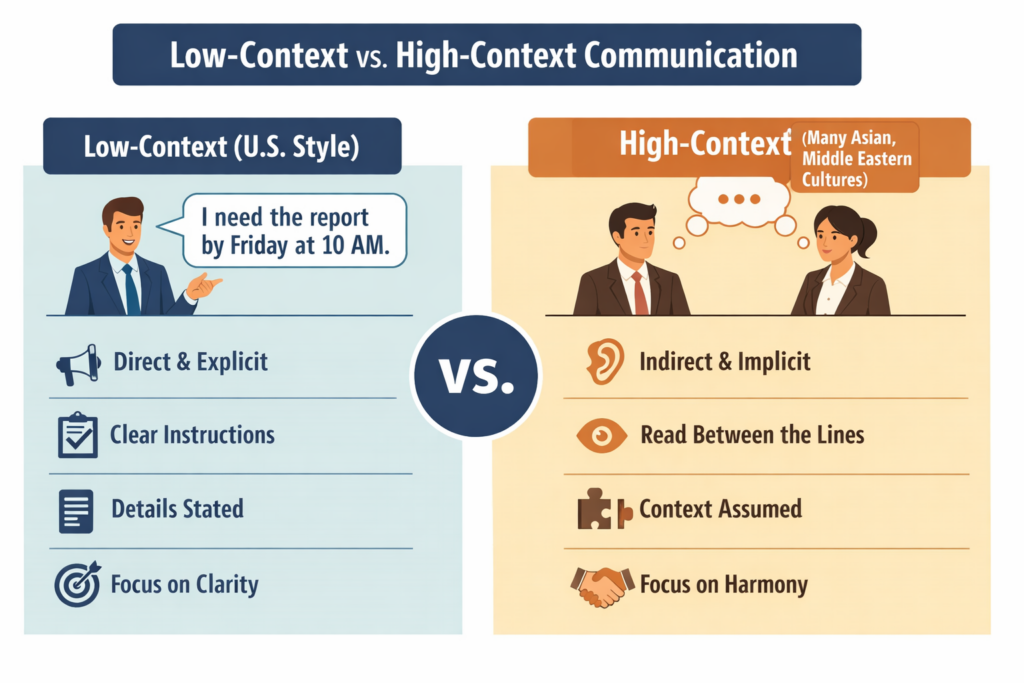
Here’s a real example from my team:
What Priya (from India) wrote:
“Regarding the Q3 budget review, there might be some areas we could potentially revisit if the timeline permits further analysis.”
What her American manager heard:
“I’m not sure what you’re asking me. Do you need more time or not?”
What she should have written:
“I need 3 additional days to complete the Q3 budget review. Without this extension, I’ll have to submit incomplete variance analysis for the APAC region. Can we move the deadline from Friday to Monday?”
Notice the difference? The second version states the problem, the consequence, and the proposed solution—all explicitly. No interpretation required.
I coached Priya to adopt what I call the “American directness formula”:
- State the situation clearly
- Explain the impact or consequence
- Propose a specific solution or ask a specific question
- Include a timeline
This applies to emails, meeting comments, and even casual hallway conversations. For more on this, effective email communication in the workplace has become a core professional skill.
2. Hierarchy and Initiative
In my second year managing an HR team, I had two analysts with identical technical capabilities. One was from the U.S., one from South Korea. The American analyst regularly scheduled meetings with senior leaders to present ideas. The Korean analyst waited to be invited.
After six months, the American analyst was promoted. The Korean analyst was rated “meets expectations.”
The difference wasn’t performance—it was visibility and initiative. In U.S. workplaces, you’re expected to:
- Proactively update your manager on progress (don’t wait to be asked)
- Raise problems early when you spot them
- Suggest solutions, not just identify issues
- Schedule meetings with stakeholders across the organization
- Build relationships several levels above your direct manager
This isn’t disrespectful—it’s expected. Americans call it “managing up,” and it’s a critical skill whether you’re in entry-level finance operations roles or senior management positions.
3. Disagreement and Conflict
Here’s a scenario that played out in a budget meeting last quarter:
My CFO presented a cost-cutting proposal. Ahmed, an MBA graduate from Egypt, had serious concerns about its impact on our retention metrics. But he stayed silent. After the meeting, he sent me a carefully worded email suggesting “perhaps we should gather more data before proceeding.”
By then, the decision was already made.
American meeting culture operates on the assumption that silence equals agreement. If you don’t speak up during the discussion, you’ve accepted the decision. Disagreeing privately afterward doesn’t change outcomes—it just makes you look passive-aggressive.
Here’s what I coached Ahmed to do instead:
In the meeting:
“I see two risks with this approach. First, our attrition data shows employees value professional development, which this cuts by 40%. Second, replacing a mid-level analyst costs us $75,000-$120,000. If we lose three people, we’ve wiped out the savings. Can we model a scenario where we cut training budget by 20% instead of eliminating it?”
Notice this isn’t rude or disrespectful—it’s data-driven disagreement. Americans separate intellectual challenge from personal attack. Disagreeing with an idea isn’t the same as disrespecting the person.
This mindset shift is crucial for developing soft skills for finance professionals who need to influence decisions across departments.
4. Time and Deadlines
In many cultures, deadlines are targets—guideposts that shift based on circumstances. In American corporate culture, deadlines are commitments.
When your manager asks, “Can you have this by Friday?” they’re not asking if it’s theoretically possible. They’re asking you to commit. If you say yes and deliver Monday, you’ve broken a commitment, even if the work quality is excellent.
I learned this the hard way early in my career. A project I thought was “roughly due Friday” was actually needed for a board presentation Friday at 9 AM. My manager had assumed my “yes” meant Friday morning. I thought it meant “sometime Friday-ish.” That misalignment created problems.
Now I coach international MBA graduates to always clarify:
- “You need this Friday at what time?”
- “Is Friday end of day or Friday morning?”
- “What happens if we need an extra 24 hours?”
If you genuinely can’t meet a deadline, flag it immediately—don’t wait until the last minute. Americans value early warnings over last-minute surprises.
5. Relationship Building
In many cultures, professional relationships develop slowly through formal interactions. In American workplaces, relationship-building is fast, informal, and constant.
The most successful international professionals I’ve worked with understood this quickly. They:
- Scheduled 15-minute coffee chats with colleagues in other departments
- Asked people about their weekends
- Joined company social events even when tired
- Used small talk before diving into business topics
- Built networks across organizational boundaries
This isn’t fake friendliness—it’s how work gets done. When you need a favor from someone in another department, having invested in that relationship earlier makes everything move faster.
Understanding how to align HR processes with corporate financial goals requires exactly this kind of cross-functional relationship capital.
Your First 90 Days: A Practical Roadmap
Based on watching dozens of international MBA graduates navigate their first few months, here’s what actually works:
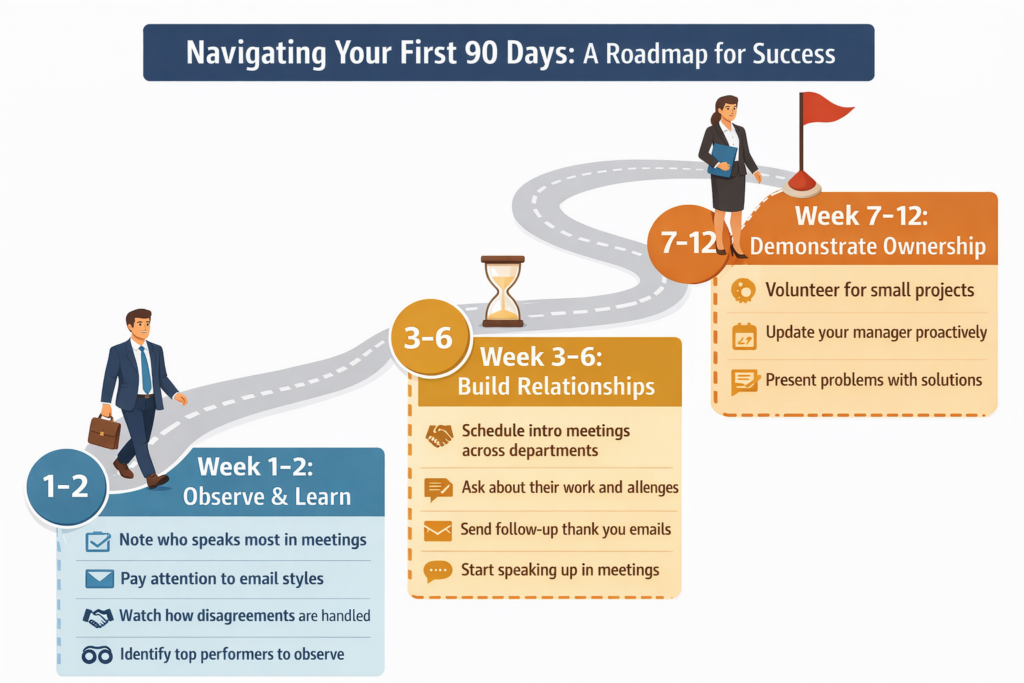
Week 1-2: Observe and Learn
Your first priority is decoding how your specific organization operates. Every company has its own micro-culture within broader American business norms.
Action steps:
- In every meeting, note who speaks most, who gets deferred to, and how decisions are actually made
- Pay attention to email patterns—length, tone, response times
- Notice how people disagree—the language they use, when they speak up
- Identify 3-5 people who seem effective and watch how they communicate
Week 3-6: Build Relationships Intentionally
Don’t wait for people to approach you. Americans expect you to initiate.
Action steps:
- Schedule 20-minute intro meetings with 10-15 people across functions
- In these meetings, ask: “What does success look like in your role?” and “How does your work intersect with [your department]?”
- Send quick thank-you emails after these conversations
- Start contributing in meetings—even small comments help build visibility
This connects to active listening skills for managers that build trust across cultural differences.
Week 7-12: Demonstrate Ownership
By month three, you should be running with projects independently.
Action steps:
- Volunteer for small projects with clear deliverables
- Send weekly progress updates to your manager (even if they don’t ask)
- When problems arise, present them with proposed solutions: “Here’s the issue, here are three options, I recommend Option 2 because…”
- Ask for feedback explicitly: “What’s one thing I could improve in how I’m approaching this work?”
Following a structured career roadmap for students in USA can help you set clear milestones for professional development.
Common Mistakes I See (And How to Fix Them)
Mistake #1: Waiting to be told exactly what to do
American managers give you the outcome they want, not the step-by-step process. If your manager says, “We need to reduce our vendor costs by 10%,” they’re not going to tell you how. They expect you to figure it out, update them on progress, and flag obstacles.
Fix: After receiving an assignment, send a brief email outlining your approach: “Here’s my plan: [3-4 bullet points]. Does this align with what you’re looking for?” This confirms direction while showing initiative.
Mistake #2: Over-explaining and under-concluding
I once received a five-paragraph email from an international MBA graduate explaining why a vendor contract needed review. The recommendation was buried in paragraph four.
Fix: Use the “bottom line up front” structure:
- First sentence: Recommendation or key point
- Next 2-3 sentences: Supporting evidence
- Final sentence: Requested action
Mistake #3: Treating feedback as personal criticism
When your manager says, “This financial model needs more detail on the assumption tab,” they mean exactly that—the deliverable needs improvement. They’re not saying you’re incompetent.
Fix: Respond with, “Got it. I’ll add breakdown of growth rate assumptions by region and have the updated version to you by tomorrow at 2 PM. Anything else you’d like to see added?” This shows you understood the feedback and you’re moving forward.
For those navigating performance discussions, understanding how to write a SWOT analysis on yourself can help frame your development areas constructively.
Mistake #4: Not building informal networks
Many international professionals focus solely on their direct manager and immediate team. In U.S. companies, your network determines how fast you advance.
Fix: Spend 30 minutes weekly connecting with someone outside your direct team. These conversations pay dividends when you need cross-functional support later.
Mistake #5: Confusing politeness with clarity
Softening language to seem polite often backfires in American business culture.
Don’t write: “I was wondering if perhaps it might be possible to potentially consider adjusting the timeline if that would be acceptable to everyone involved.”
Write: “Can we extend the deadline by three days? This would allow us to include the Q4 data, which significantly changes the recommendation.”
Decoding American Corporate Speak
Here’s a translation guide I share with every international MBA graduate I mentor:
| What Americans Say | What It Actually Means | What You Should Do |
|---|---|---|
| “Let me think about it” | “Probably no, but I’m being polite” | Follow up in 48 hours with additional supporting data |
| “That’s interesting” | Could be genuine interest OR polite dismissal | Ask: “Would it be helpful if I developed this further?” |
| “Let’s take this offline” | “This conversation is derailing the meeting” | Schedule separate time to discuss with relevant people only |
| “I’ll loop you in” | “I’ll include you if I remember” | Send a calendar invite to ensure you’re included |
| “Do you have bandwidth?” | “I need you to do this” | Negotiate timeline/scope, but don’t say flat no |
| “Quick question…” | Usually not quick | Block 15-30 minutes if possible |
Learning these patterns is part of developing the practical financial modelling skills every HR manager should know—it’s about reading context and adjusting communication.
Communication Templates That Work
Template 1: Raising a Problem
Subject: Timeline Risk – Q2 Marketing Campaign
Hi [Manager],
I’ve identified a risk with our Q2 campaign timeline:
Situation: Creative agency deadline is March 15, but legal review typically takes 7-10 business days
Impact: If legal needs the full 10 days, we’ll miss our March 20 launch window
Options:
- Move launch to March 25 (low risk, delays revenue by one week)
- Start legal review now with draft creative (medium risk, may require rework)
- Hire expedited legal review service ($8K additional cost)
Which direction would you prefer? Happy to discuss today if that’s helpful.
[Your name]
Template 2: Disagreeing Constructively
In a meeting: “I see the logic in consolidating vendors, but I want to flag two data points: our vendor satisfaction scores dropped 30% the last time we did this in 2023, and we spent $45K managing the transition. Before we decide, can we model what the breakeven timeline looks like given those historical costs?”
Template 3: Managing Up (Weekly Update)
Subject: Week of Feb 3 – Project Update
Completed:
- Vendor analysis for top 15 suppliers (see attached)
- Initial cost reduction scenarios ($200K-$400K range)
In Progress:
- Contract negotiation with Vendor A (call scheduled Thursday)
Blockers:
- Need Finance to confirm if savings can be recognized in Q1 or Q2 (affects which contracts to prioritize)
Next Week:
- Complete vendor interviews, deliver final recommendation
Let me know if you need anything before Friday’s leadership meeting.
For professionals looking to strengthen these skills systematically, exploring how to list cross-functional finance and HR skills on a US resume shows how these competencies translate into career advancement.
Building Cross-Cultural Credibility Fast
The international MBA graduates who succeed fastest in my experience do three things consistently:
1. They explicitly acknowledge the adjustment
Instead of pretending they understand everything, they say things like: “I want to make sure I’m communicating clearly since business communication norms differ across cultures. If I’m ever unclear, please let me know directly.”
This makes you seem self-aware, not incompetent.
2. They ask cultural questions without embarrassment
“In your experience, is it normal to schedule meetings directly with VPs, or should I route through my manager first?”
“When people say ‘let’s grab coffee,’ do they mean immediately or is that code for ‘let’s schedule something’?”
Americans appreciate directness, including questions about norms.
3. They leverage their global perspective as an asset
When everyone in the room thinks about a problem through a purely American lens, your international experience is valuable. Use it.
“In my experience working with European clients, they prioritize data privacy much more heavily. If we’re planning to expand there, we might want to build that into the product roadmap now rather than retrofitting later.”
This is particularly relevant for those considering whether an online MBA is worth it for mid-career transition—your international background combined with U.S. business education creates unique value.
What Success Looks Like
Let me return to Rajesh, the financial analyst I mentioned at the beginning. After six months of coaching, here’s what changed:
Before:
- Waited for assignments, completed them perfectly, submitted them quietly
- Stayed silent in meetings unless directly asked
- Sent long, carefully worded emails
- Only interacted with his direct manager
After:
- Proactively identified cost-saving opportunities and presented them to leadership
- Contributed analysis and questions in planning meetings
- Sent concise emails with clear asks and deadlines
- Built relationships with colleagues in Marketing, IT, and Operations
His performance rating went from “meets expectations” to “exceeds expectations.” More importantly, he stopped feeling like he was failing despite doing good work.
My Thoughts
Navigating U.S. workplace expectations as an international MBA graduate isn’t about abandoning your cultural identity or becoming “Americanized.” It’s about code-switching—understanding the professional norms of your work environment and adapting your communication style while maintaining your authentic perspective.
The international professionals I’ve seen thrive in U.S. companies are those who:
- Learned American business communication norms explicitly
- Practiced direct communication even when it felt uncomfortable
- Built broad networks across organizational boundaries
- Asked questions about cultural expectations without embarrassment
- Leveraged their international experience as a strategic advantage
Your MBA gave you the technical foundation. These cultural navigation skills will determine how effectively you can apply that knowledge in American corporate environments.
Start with one small change this week. Maybe it’s sending a more direct email. Maybe it’s speaking up once in your next meeting. Maybe it’s scheduling coffee with someone outside your immediate team. Each small adjustment builds momentum.
The professionals who succeed aren’t the ones who had the easiest time adjusting—they’re the ones who acknowledged the gap and deliberately worked to close it.
Understanding HR analytics and how it improves financial performance and recognizing the impact of tax law changes on corporate payroll and HR compliance will further position you as a strategic partner in U.S. organizations.
The content on Business Tax Hub is provided for educational and informational purposes only… [rest of disclaimer text]

Karthick Raja is an MBA-qualified Finance & HR professional and founder of Business Tax Hub, with 10+ years of hands-on experience managing finance operations, taxation, payroll compliance, and HR functions. He helps students and professionals navigate the U.S. corporate landscape by translating real-world business experience into practical, job-ready career growth.